

 Back
Back


 Back to
topics
Back to
topics




Table of Contents

 17-Sep-2025
Author-Gary Moore
Collaboration, focus, and continuous improvement define high-performing teams. At the heart of this success is the Scrum Master, a servant-leader who guides Agile teams and clears obstacles along the way. As the demand for skilled Scrum Masters continues to grow, preparing well for interviews has never been more important.
If you think you've got the mettle to manage a Scrum team, then this collection of the top Scrum Master Interview Questions and answers will help you carve out a fruitful career. So read on, master the Scrum essentials, get ready to impress hiring managers and land your dream role in the Agile universe!
Table of Contents
35 Scrum Master Interview Questions With Answers
1) What is Scrum?
a) Define the roles in Scrum?
b) What are the Scrum values?
c) What is ‘Scrum of Scrums'?
d) How would you scale Scrum?
e) Explain Scrumban
f) What are the responsibilities of the Scrum Team?
g) Differentiate between Agile and Scrum
h) What are the artefacts of the Scrum Process?
i) What is Sprint 0 and Spike?
2) Conclusion
35 Scrum Master Interview Questions With Answers
This section brings you a curated list of the essential Scrum Master Interview Questions and answers to help you shine. So, dive in and get ready to showcase your Scrum expertise with confidence and clarity.
1) What is Scrum?
This question is intended to check your understanding of the Scrum framework.
Sample Answer:
“Scrum is an Agile framework that helps teams work collaboratively to deliver value in small, manageable increments. It focuses on transparency, inspection, and adaptation, with defined roles, events, and artefacts guiding the process to achieve continuous improvement and customer satisfaction.”

2) Define the roles in Scrum?
This question is designed to assess your knowledge of Scrum roles and responsibilities.
Sample Answer:
“Scrum has three key roles:
Product Owner: Manages the product backlog and priorities
Scrum Master: Facilitates and supports the team in applying Scrum
Development Team: Self-organise to deliver potentially shippable increments each sprint.”
3) What are the Scrum values?
This question will test if you understand the guiding principles that shape team behaviour and decision-making in Scrum.
Sample Answer:
“Scrum values are Commitment, Courage, Focus, Openness, and Respect. They guide how the team works together, promote transparency, and build trust. Living these values helps create a supportive environment where the team can deliver high-quality work consistently.”
4) What is ‘Scrum of Scrums'?
This question will evaluate your awareness of the techniques used to coordinate work across multiple Scrum teams.
Sample Answer:
“Scrum of Scrums refers to a meeting where representatives from multiple Scrum teams coordinate progress and address dependencies. It’s used in large projects to maintain alignment across teams, resolve cross-team issues, and ensure smooth collaboration towards a shared goal.”
5) How would you scale Scrum?
This question will help the interviewer gauge your knowledge of scaling frameworks.
Sample Answer:
“I’d use frameworks like SAFe, LeSS, or Nexus, depending on the organisation’s needs. Scaling involves coordinating multiple Scrum teams, synchronising sprints, managing dependencies, and maintaining transparency so all teams work towards the same product vision.”
6) Explain Scrumban
This question is designed to test your knowledge of hybrid Agile methodologies.
Sample Answer:
“Scrumban combines Scrum’s structured roles and events with Kanban’s focus on visual workflow and continuous delivery. It’s often used when teams want Scrum’s organisation but also need Kanban’s flexibility for handling ongoing or unpredictable work.”
7) What are the responsibilities of the Scrum Team?
Your answer to this question will confirm your understanding of team accountability.
Sample Answer:
“The Scrum Team works together to deliver valuable increments each sprint. They self-organise, refine the backlog, commit to goals, uphold quality, and inspect and adapt regularly. Everyone shares responsibility for delivering value and achieving the sprint goal.”
Become the catalyst for Agile success with our comprehensive Scrum Master Training - Register now!
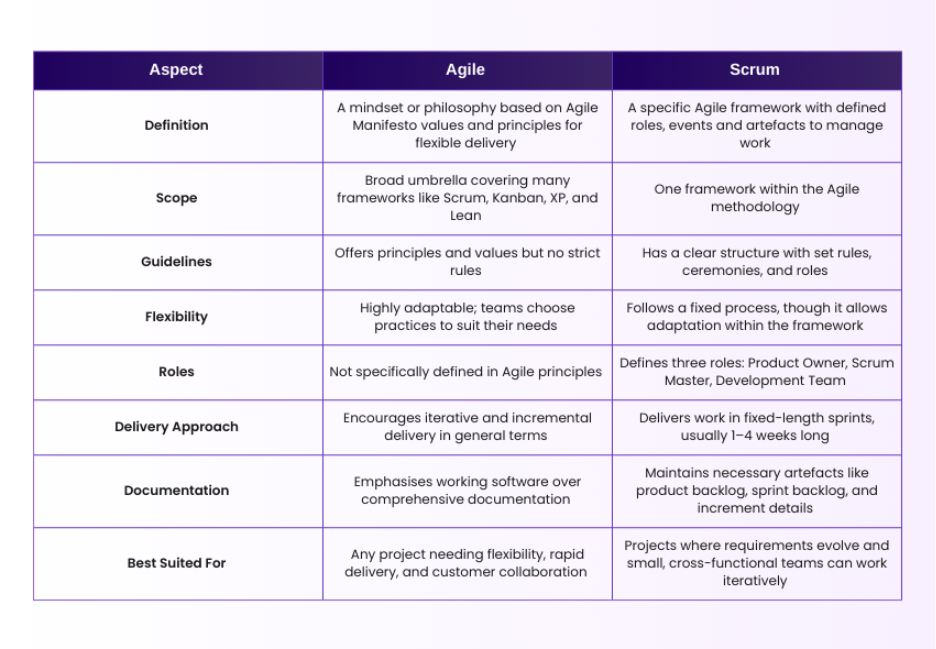
8) Differentiate between Agile and Scrum
This question will check how well you understand the relationship between Agile and Scrum.
Sample Answer:
“Agile is a mindset with values and principles for flexible, customer-focused delivery. Scrum is one Agile framework that applies these principles through defined roles, events, and artefacts to manage work in short, iterative cycles.”
9) What are the artefacts of the Scrum process?
This question will check your knowledge of the key artefacts that provide transparency and track progress in Scrum.
Sample Answer:
“Scrum artefacts are the Product Backlog, Sprint Backlog, and Increment. They provide transparency into the work, progress, and goals, ensuring the team and stakeholders share the same understanding of what’s being developed and delivered.”
10) What is Sprint 0 and Spike?
This question is intended to assess if you know preparatory and research practices.
Sample Answer:
“Sprint 0 is a planning sprint to set up environments, tools, and initial backlog items before development begins. A Spike is a timeboxed research task to explore uncertainty, test ideas, or reduce technical risk before committing to work.”
11) Explain velocity?
This question will help gauge your understanding of measuring a team’s work output for forecasting purposes.
Sample Answer:
“Velocity is the amount of work a team completes in a sprint, usually measured in story points. It helps forecast future delivery capacity but should be used as a planning guide, not a performance target.”
12) Who is a Scrum Master? And what does he/she do?
Your answer to this question will confirm your grasp of the Scrum Master role, its purpose and key responsibilities.
Sample Answer:
“A Scrum Master is a facilitator and coach for the Scrum Team. They ensure the team follows Scrum principles, remove impediments, support collaboration, and help create a productive environment for delivering high-value increments.”
13) What are the core skills of a Scrum Master?
This question is intended to check if you recognise the role’s core competencies.
Sample Answer:
“The main skills of a Scrum Master include facilitation, communication, conflict resolution, coaching, adaptability, and servant leadership. A Scrum Master must also understand the Agile principles deeply and know how to guide teams through challenges without imposing solutions.”
14) What is empirical process control in Scrum?
This question will check if you understand Scrum’s foundation in transparency, inspection and adaptation.
Sample Answer:
“Empirical process control is based on transparency, inspection, and adaptation. It means decisions are made using observed facts, allowing the teams to quickly adapt to change and improve outcomes through continuous learning and adjustment.”
Drive value from idea to delivery. Sign up for our Scrum Product Owner Certification now!
15) What is a user story?
The main intent of this question is to see if you can explain a core Agile practice from a user’s perspective.
Sample Answer:
“A user story refers to a simple description of a feature from the user’s perspective, usually in the format “As a [user], I want [goal] so that [reason].” It helps the teams maintain their focus on delivering customer value.”
16) How is estimation done in a Scrum project?
This will help assess your knowledge of common Agile estimation techniques and their purpose.
Sample Answer:
“Estimation is often done using techniques like Planning Poker, T-shirt sizing or story points. It’s a team activity that measures effort and complexity rather than exact hours, helping with planning and prioritisation.”
17) What are the three pillars of Scrum?
This question will verify your understanding of the foundational principles behind Scrum’s effectiveness.
Sample Answer:
“The three pillars of Scrum include: Transparency, Inspection and Adaptation. They ensure that everyone has a clear view of progress, regularly checks the outcomes and adjusts processes to improve effectiveness.”
18) What is the agenda of the daily stand-up session?
This question is intended to check if you understand the purpose and structure of daily Scrum meetings.
Sample Answer:
“The daily stand-up lets team members share what they did yesterday, what they’ll do today and any blockers they’ve experienced. It keeps everyone aligned and helps identify issues early. It also promotes transparency and encourages quick decision-making to keep the sprint on track.”
19) How to track sprint progress?
This question is intended to check if you know methods for monitoring progress and identifying risks during a sprint.
Sample Answer:
“Sprint progress can be tracked using burndown charts, task boards, and daily updates. These tools help visualise work completed, work remaining, and any risks to meeting the sprint goal.”
20) What is timeboxing in Scrum?
The intent behind this question is to assess your understanding of setting fixed time limits for Scrum events.
Sample Answer:
“Timeboxing sets a fixed maximum duration for events or tasks, that helps us to ensure focus and efficiency. For example, sprints are timeboxed to a set number of weeks, and meetings have defined time limits.”
21) What’s the Minimum Viable Product (MVP) in Scrum?
This will test your knowledge of delivering early value and gathering feedback through incremental releases.
Sample Answer:
“An MVP refers to a product's simplest version that delivers core value to users. It lets the team gather feedback quickly, validate their ideas and decide the next development steps, reducing risk and focusing on delivering features that truly matter.”
Own every development cycle and create value with ease. Sign up for our Scrum Developer Training now!
22) Define DOD and how it could be achieved
This question will assess knowledge of quality and completion standards.
Sample Answer:
“The Definition of Done (DoD) is an agreed checklist ensuring a product increment meets quality standards before it’s released. It’s achieved by team consensus, clear criteria, consistent testing, code reviews, and meeting all acceptance requirements before marking work as complete.”
23) What is scope creep? How do overcome it?
With this question, the interviewer will evaluate your ability to manage uncontrolled changes to the project scope in Scrum.
Sample Answer:
“Scope creep is when extra features or requirements are added without proper review. I overcome it by maintaining a clear product backlog, prioritising with the Product Owner and ensuring all changes go through proper discussion and stakeholder agreement before implementation.”
24) Mention some of the cases where Scrum is not suggested?
This question will help spotlight your awareness regarding Scrum’s limitations.
Sample Answer:
“Scrum may not suit projects with fixed, unchangeable requirements, highly regulated environments with no flexibility, or teams lacking cross-functional skills. It also struggles in organisations unwilling to embrace Agile principles or commit to iterative delivery and collaboration.”
25) Is it possible to cancel a sprint process? And who can cancel the process?
This question is designed to assess your knowledge of sprint cancellation rules and decision-making authority in Scrum.
Sample Answer:
“Yes, a sprint can be cancelled if the sprint goal becomes obsolete. Only the Product Owner can decide this, though they may consult the team and stakeholders before making the decision to ensure alignment and minimise wasted effort.”
26) Can you name some of the tools used in the Scrum project?
This question will check your familiarity with Agile tools.
Sample Answer:
“Popular Scrum tools include Jira, Trello, Asana, ClickUp, and Azure DevOps. I’m well-versed with these tools. They help manage backlogs, track sprint progress, visualise tasks, and enable collaboration between team members and stakeholders throughout the project.”
27) What is your favourite Scrum event?
This will help the interviewer learn about your personal preferences and insights into Scrum practices.
Sample Answer:
“My favourite is the sprint review because it’s a collaborative moment to showcase completed work, get real feedback from stakeholders and celebrate progress. It’s motivating for the team and ensures we’re still delivering value that’s aligned with customer needs.”
28) What is your experience in this industry?
This will help understand your professional background and how it relates to role of a Scrum Master.
Sample Answer:
“I’ve worked in the [industry] for several years, managing cross-functional Agile teams. My experience includes delivering multiple successful projects, guiding teams through Scrum adoption, and improving delivery processes to improve quality, speed and stakeholder satisfaction.”
29) What are the Potential Risks of Scrum? And How Can They be Addressed?
This question will assess your ability to identify and mitigate challenges in applying Scrum.
Sample Answer:
“Risks include unclear backlog items, lack of stakeholder engagement and poor adaptation to change. I address them by ensuring backlog refinement, ensuring strong communication and encouraging continuous improvement through retrospectives and team alignment.”
30) How would you deal with a difficult stakeholder?
This will help your potential employer evaluate your Stakeholder Management and Conflict Resolution skills.
Sample Answer:
“I’d listen actively to understand their concerns, communicate openly and find common ground. I’d involve them in backlog prioritisation and keep them updated regularly, aiming to build trust and maintain a productive relationship.”
31) A team member is unwilling to embrace Scrum, and it’s impacting the project. How would you handle this?
This question will help the interviewer see how you handle resistance to change.
Sample Answer:
"I’d have a one-on-one discussion to understand their concerns, explain the benefits of Scrum and involve them in finding ways to adapt. Building trust and showing quick wins can help them see the value in the process."
32) How did you handle a mistake that was made?
This question will help the interviewer gauge how you take responsibility, resolve issues and learn from mistakes.
Sample Answer:
"I believe in owning mistakes, addressing them quickly and learning from them. I’d communicate the issue openly with the team, work together on a fix and adjust processes to prevent similar mistakes in the future."
33) What step would you take if a team member fails to complete a task for a sprint?
This will assess your support strategies for team members facing difficulties.
Sample Answer:
"I’d first understand the reason, then work with the team to reassign or adjust tasks. We’d update the sprint backlog if needed, focusing on supporting the team member while still aiming to meet the sprint goal."
34) What are the anti-patterns that a Scrum Master might fall during a sprint session?
This question will test your awareness of bad practices that can undermine Scrum’s effectiveness.
Sample Answer:
"Anti-patterns include micromanaging, skipping retrospectives, allowing scope creep, and focusing too much on velocity over value. Avoiding these requires servant leadership, maintaining Scrum discipline and keeping the team focused on generating value."
35) How will you know that Agile practices are working perfectly for your organisation?
This will evaluate your ability to measure Agile success in an organisation.
Sample Answer:
"I’d look for improved delivery speed, higher-quality outputs, engaged teams, and satisfied customers. Regular retrospectives, stakeholder feedback and measurable business outcomes indicate that Agile practices are delivering real value and meeting organisational goals."
Conclusion
Cracking a Scrum Master interview is about showcasing leadership, agility and a mindset for continuous improvement. With the frequently asked Scrum Master Interview Questions and answers outlined in this blog, you’re now equipped to step into the interview room with confidence. So go ahead, lead the sprint and land that dream role.
Lead the change and sprint ahead with our comprehensive Agile Project Management Training - Register now!