

 Back
Back


 Back to
topics
Back to
topics




Table of Contents

 25-Jul-2026
Author-Maria Thompson
Projects rarely fail because teams lack talent. More often, they struggle because responsibilities are unclear. When multiple people assume ownership of the same task, or worse, no one takes ownership at all, delays and costly mistakes can quickly follow. This challenge becomes even greater as projects grow in size and complexity.
A RACI Chart offers a practical solution by clearly defining who is Responsible, Accountable, Consulted and Informed for every project activity. Far more than a simple responsibility matrix, it creates transparency and ensures the right people are involved at the right time. In this blog, we'll explore What is a RACI Chart, why it matters, and how organisations can use it to strengthen accountability and deliver projects more effectively
What is a RACI Chart?
The acronym RACI stands for Responsible, Accountable, Consulted, and Informed. A RACI Chart, also known as a Responsibility Assignment Matrix (RAM), is a Project Management tool for defining and clarifying roles and responsibilities for project tasks, activities, and deliverables. It helps teams discern who is responsible for completing work, who has decision-making authority, who should be consulted for expertise, and who needs to stay informed about progress.
By assigning these roles to each task, organisations can reduce confusion, improve communication, strengthen accountability, and ensure projects run more efficiently. RACI Charts are particularly valuable in complex projects where multiple stakeholders and teams are involved.

What are the Four RACI Roles?
The four roles within a RACI Chart help define how individuals contribute to a project and ensure every task has clear ownership. By assigning the appropriate RACI role to each activity, teams can improve accountability, streamline communication, and avoid confusion over responsibilities.
1) Responsible
The Responsible role is assigned to the person or people who carry out the work required to complete a task or deliverable. These individuals are directly involved in executing the activity and ensuring it is completed according to project requirements. A task can have multiple responsible individuals, particularly when collaboration is required.
2) Accountable
The Accountable role belongs to the individual who ultimately owns the task and is answerable for its successful completion. This person approves the work, makes key decisions, and ensures that responsibilities are fulfilled. To maintain clear accountability, each task should ideally have only one accountable person.
3) Consulted
Consulted individuals are subject matter experts or stakeholders whose knowledge and feedback contribute to the completion of a task. They provide guidance, recommendations, and insights that help teams make informed decisions. Communication with consulted parties is typically a two-way process involving discussion and collaboration.
4) Informed
The Informed role includes individuals who need to stay updated on project progress, decisions, or outcomes but are not directly involved in completing the work. These may include senior leaders, stakeholders, clients, or other departments. Keeping informed parties updated promotes transparency, alignment, and effective stakeholder management.
When Should You Use a RACI Framework?
Knowing What is a RACI Chart is not enough. Before implementing a RACI framework, it is important to understand when it provides the greatest value. Below are few points why you should use a RACI framework:
1) When Multiple Teams or Stakeholders are Involved
A RACI framework is particularly useful for cross-functional projects where several departments, teams, or stakeholders contribute to the same initiative. It clarifies responsibilities and prevents confusion over who owns specific tasks.
2) When Roles and Decision-making are Unclear
If team members are uncertain about who should complete, approve, review, or receive updates on a task, a RACI framework helps establish clear ownership and accountability, reducing delays and miscommunication.
3) When Managing Complex Projects
Large or complex projects often involve numerous activities, dependencies, and contributors. A RACI framework provides a structured approach to assigning responsibilities, ensuring tasks are completed efficiently and stakeholders remain aligned throughout the project lifecycle.
Turn your project expertise into a globally recognised credential with our PMI® Certification Courses - Sign up now!
What are the Benefits of RACI Charts?
The RACI model helps define roles and responsibilities with greater clarity across a project. This structured approach improves accountability, supports efficient decision-making, and strengthens collaboration among stakeholders. Below are some of the key benefits of using a RACI Chart.
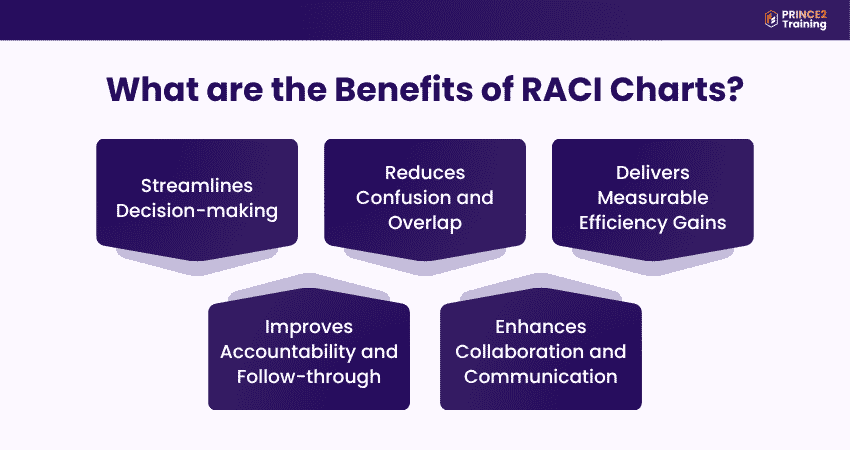
1) Streamlines Decision-making
By identifying a single accountable individual for key decisions, a RACI Chart removes uncertainty around authority and approvals. This helps prevent decision-making bottlenecks, reduces delays caused by conflicting opinions, and ensures that important decisions are made by the appropriate person. Teams can therefore respond more quickly to challenges and keep projects moving forward.
Clear decision-making structures also improve confidence among team members, as everyone knows who has the authority to approve actions and resolve issues. This reduces unnecessary escalations, supports faster problem-solving, and enables projects to maintain momentum even when unexpected changes arise.
2) Reduces Confusion and Overlap
Clear role assignments ensure that every task has designated ownership and responsibilities. This minimises duplicated effort, prevents important activities from being overlooked, and reduces misunderstandings among team members. As a result, projects run more smoothly and resources are used more effectively.
When responsibilities are clearly documented, team members can focus on their assigned work without uncertainty about who is doing what. This improves coordination across departments, reduces communication gaps, and helps create a more organised and productive working environment.
3) Delivers Measurable Efficiency Gains
Through a structured allocation of responsibilities, a RACI Chart helps teams spend less time clarifying roles and resolving ownership issues. Resources can be utilised more effectively, allowing greater focus on project delivery and strategic objectives. This contributes to improved productivity and operational performance.
By reducing ambiguity and unnecessary discussions, teams can complete tasks more efficiently and maintain consistent progress throughout the project lifecycle. The result is faster execution, improved resource management, and a more streamlined approach towatds achieving project goals.
4) Improves Accountability and Follow-through
Defined responsibilities create a stronger sense of ownership among team members. When individuals understand exactly what they are accountable for, they are more likely to meet expectations, fulfil commitments, and complete tasks within agreed timelines. This supports consistent follow-through and successful project outcomes.
Greater accountability also makes it easier to track the progress and identify potential issues before they escalate. Project Managers can monitor responsibilities more effectively, ensuring that deliverables remain on schedule and that performance expectations are clearly understood.
5) Enhances Collaboration and Communication
Effective stakeholder involvement is encouraged by clearly identifying who should be consulted and informed throughout the project. This ensures relevant information is shared with the right people at the right time, reducing the risk of miscommunication and missed updates.
By establishing structured communication channels, a RACI Chart helps teams collaborate more effectively across functions and departments. Stakeholders remain engaged in decision-making where appropriate, while everyone involved gains greater visibility into project progress and expectations.
What are the Limitations of RACI Charts?
While RACI Charts are effective for clarifying roles and responsibilities, they are not without limitations. Understanding these challenges can help teams use RACI Charts more effectively.
1) May Oversimplify Complex Roles: Some team members contribute in multiple ways throughout a project, making it difficult to assign them to a single RACI category. This can result in responsibilities that do not fully reflect their level of involvement or influence.
2) Can Become Outdated Quickly: Projects evolve over time, and responsibilities may change as new requirements emerge. If a RACI Chart is not reviewed and updated regularly, it can lose relevance and create confusion rather than clarity.
3) Struggles to Capture Dynamic Team Structures: In many projects, individuals take on different responsibilities depending on the situation. A static RACI Chart may not accurately represent these shifting roles, particularly in fast-paced or Agile environments.
4) Does Not Reflect Organisational Influence: A RACI Chart defines formal responsibilities but does not account for workplace dynamics and informal authority. In practice, decisions may still be influenced by senior stakeholders or subject matter experts who are not designated as decision-makers within the chart.
Launch your Project Management career with Introduction To Project Management Course – Register now!
Steps to Create a RACI Chart
Below are the steps to create a RACI Chart:
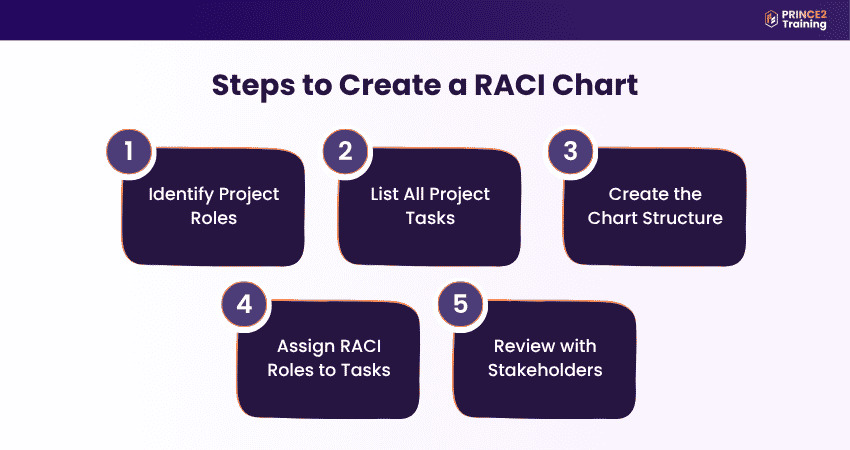
1) Identify Project Roles
Begin by identifying all individuals, teams, and stakeholders involved in the project. Include everyone who will contribute to tasks, make decisions, provide input, or require updates. A complete list of roles ensures responsibilities can be assigned accurately.
2) List All Project Tasks
Break the project down into specific tasks, deliverables, milestones, or work packages. Each activity should be clearly defined and included in the chart. A detailed task list helps prevent important responsibilities from being overlooked.
3) Create the Chart Structure
Set up a matrix with project tasks listed in rows and project roles displayed across columns. This format provides a clear visual overview of responsibilities. A well-structured chart makes role assignments easier to understand and manage.
4) Assign RACI Roles to Tasks
Assign Responsible, Accountable, Consulted, and Informed roles for each task based on stakeholder involvement. Ensure every activity has a clear owner and decision-maker. Balanced role allocation helps avoid confusion and accountability gaps.
5) Review with Stakeholders
Share the completed chart with stakeholders and project team members for validation. This helps confirm that responsibilities are realistic, understood, and agreed upon by everyone involved. Reviewing the chart also allows adjustments before project execution begins.
Examples of the RACI Model
The RACI model can be applied across a wide range of projects and business functions to clarify responsibilities and improve accountability. Below are few examples of RACI Model:
1) Producing a Marketing Handout
When creating a marketing handout, a content writer may be Responsible for drafting the material, while the Marketing Manager is Accountable for approving the final version. Designers and subject matter experts may be Consulted to provide creative input and technical accuracy. Sales teams and senior stakeholders are typically Informed about progress and the final deliverable.
2) Developing a New Software Product
In a Software Development project, Developers are often Responsible for building and testing product features, while the Product Manager is accountable for making sure the product meets business objectives. Business Analysts, UX Designers, and technical specialists may be Consulted throughout the development process. Executives, customers, and other stakeholders are generally Informed about key milestones, releases, and project outcomes.
Best Practices for RACI Chart
To get the most value from a RACI Chart, follow these best practices for clarity, accountability, and effective collaboration:
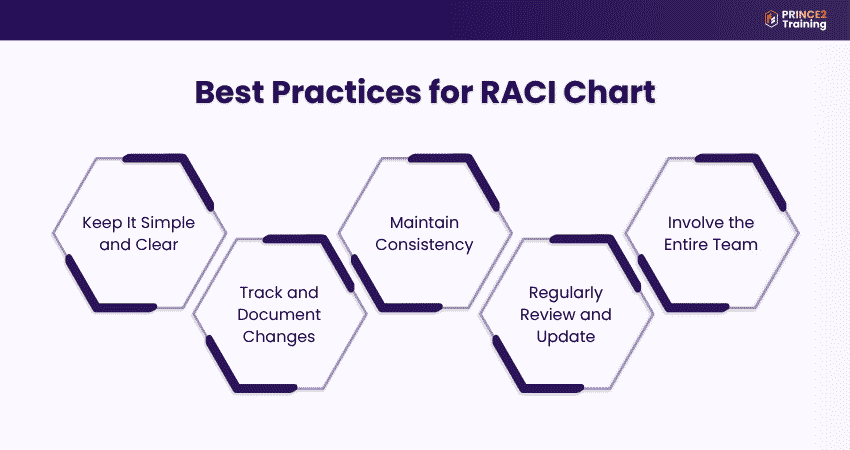
1) Keep it Simple and Clear
Focus on key tasks, deliverables, and stakeholder roles when creating the chart. Avoid adding unnecessary details that can overcomplicate the matrix. A clear and straightforward RACI Chart is easier for teams to follow and use effectively.
2) Track and Document Changes
Project responsibilities can evolve as requirements, priorities, or team structures change. Documenting updates helps maintain an accurate record of role assignments and decisions. This ensures everyone works from the most current version of the chart.
3) Maintain Consistency
Apply RACI definitions consistently across all project activities and departments. Clear and uniform role assignments reduce confusion and help stakeholders understand their responsibilities. Consistency also makes the chart easier to interpret and manage.
4) Regularly Review and Update
Schedule periodic reviews to confirm that responsibilities still align with project needs. Updating the chart as the project evolves helps maintain its accuracy and relevance. A regularly maintained RACI Chart remains a reliable source of accountability.
5) Involve the Entire Team
Engage team members and stakeholders when creating and reviewing the chart. Their input helps validate responsibilities, identify gaps, and ensure role assignments are realistic. Collaboration also increases understanding and commitment across the project team.
Conclusion
Understanding What Is a RACI Chart is essential for improving accountability, communication, and role clarity within a project. By defining who's Responsible, Accountable, Consulted, and Informed, organisations can reduce confusion, streamline decision-making, and improve collaboration across teams. While the framework should be reviewed and adapted as projects evolve, a well-maintained RACI Chart remains a indispensable tool for ensuring successful project execution and stakeholder alignment.
Train smart and conquer the PMP® exam with a results-driven boot camp experience. Sign up for our PMP® Exam Prep Boot Camp Training now!
Frequently Asked Questions?
A RACI Chart should be used whenever roles and responsibilities are to be clearly defined to prevent confusion, duplication of work, or gaps in accountability. It is particularly valuable for projects involving multiple teams, stakeholders, or complex workflows, where clear ownership is essential for successful delivery.
The "Golden Rule" of RACI is that every task should have one and only one Accountable person. While multiple individuals can be Responsible, there must be a single person who owns the outcome and approves the work. This prevents confusion, strengthens accountability, and ensures clear decision-making throughout the project.
When reviewing a completed RACI Chart, check that every task has one Accountable owner, responsibilities are clearly assigned, and no role is overloaded or missing. Ensure the stakeholders are appropriately Consulted or Informed and verify that the chart accurately reflects current project responsibilities and workflows.