

 Back
Back


 Back to
topics
Back to
topics




Table of Contents
 13-Mar-2026
Author-David Walter
Every successful project must begin with a clear financial roadmap. This is where a Project Budget comes in to turn project vision into a lasting and lucrative reality. From estimating expenses to monitoring spending, effective budgeting keeps projects aligned with goals and expectations.
Without a well-structured budget, even the best strategies can struggle to stay on track. In this blog, we explore What is a Project Budget, why it matters in Project Management and the practical steps you can follow to create one successfully. So read on and replace costly surprises with smooth execution!
What is a Project Budget?
A Project Budget is a plan that outlines how much money will be spent, where it will be allocated and when it will be spent throughout a project. By preparing a budget and tracking expenses during the project, organisations can minimise the risk of resource shortages or overspending.
Planning a budget before starting a project helps define the scope of work and manage costs. It also supports funding approval, as stakeholders can clearly see how expenses align with project objectives. As the project moves forward, the budget acts as a benchmark to compare planned and actual spending.

The Importance of Project Budget
These are the reasons why a Project Budget is important:
1) Assess Financial Feasibility:
A Project Budget evaluates whether sufficient financial resources are available and determines if the project can proceed within its financial limits.
2) Supports Project Prioritisation:
When multiple projects run at the same time, budgets help organisations decide which initiatives should receive priority based on value, ROI, and strategic goals.
3) Improves Resource Allocation:
Budgets guide how funds and resources are distributed across tasks, ensuring each activity receives the appropriate level of support.
4) Controls Project Spending:
Setting spending limits allows teams to track expenses and take corrective action if costs begin to exceed the planned budget.
5) Helps Identify Financial Risks Early:
A well-planned budget highlights potential financial challenges early, allowing teams to respond proactively and reduce risks.
What are the Main Components of a Project Budget?
A Project Budget includes several key elements that represent different types of costs required to plan and manage a project effectively. The main components include:
1) Labour Costs
These are the expenses related to the people involved in the project. This includes salaries, wages, employee benefits and training. Since labour often forms a large portion of the budget, accurate estimation is essential. Understanding the skills required, assigned tasks and time needed helps calculate these costs more precisely.
2) Material Costs
Material costs cover all physical and digital resources needed for the project, such as raw materials, equipment, machinery, software and office supplies. Identifying the correct materials, quantities, and pricing is important, as any changes in requirements or market prices can significantly impact the overall budget.
3) Overhead Costs
Overhead costs refer to indirect expenses that support the project but are not tied to specific tasks. These may include rent, utilities, insurance, and administrative expenses. Although they are not always obvious, accurately estimating these costs is necessary to understand the project’s true total cost.
4) Contingency Funds
Contingencies are reserved funds used to handle unexpected expenses or project changes. They act as a financial buffer and are usually calculated as a percentage of the total project cost. Projects with higher uncertainty or risk typically require a larger contingency allocation.
Master the method trusted by global project leaders in our range of
PRINCE2® Certifications
- Sign up now!
How to Create a Project Budget?
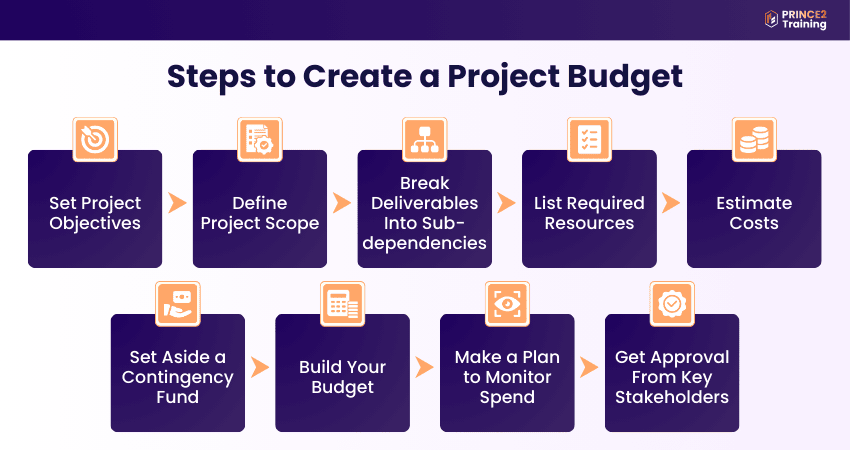
Creating a Project Budget can feel complex, but following a structured process makes it manageable. Here are the proven steps that help organisations plan and control project finances:
1) Set Project Objectives
Begin by defining what you want to achieve by the end of the project. Clear objectives guide the direction of the work and help measure success. Using the SMART approach, short for specific, measurable, achievable, realistic, and time-bound, can help create well-defined goals.
2) Define Project Scope
After setting objectives, outline the scope of the project. This defines the work involved, deliverables, timelines and boundaries. It also requires considering available resources, time constraints and non-goals to avoid scope creep and unnecessary spending.
3) Break Deliverables Into Sub-dependencies
List all project deliverables and divide them into smaller tasks or dependencies. This makes planning easier and helps identify hidden costs that might otherwise be overlooked. Tools such as a Work Breakdown Structure (WBS) can visually organise these elements.
4) List Required Resources
Determine the resources needed for each task. Resources may include team members, equipment, training, workspace, research data, professional services, procurement needs and travel requirements. Being specific ensures a more accurate budgeting process.
5) Estimate Costs
Calculate the expected costs associated with each resource and task. Several estimation methods can be used, such as bottom-up estimation, analysing past Project Budgets, working within a fixed budget or planning for different scenarios.
6) Set Aside a Contingency Fund
Unexpected events can occur during a project. Allocating a contingency reserve (typically around five to 10% of the total budget) helps manage risks and cover unforeseen expenses without disrupting the project.
7) Build Your Budget
Compile all the cost estimates into a structured budget. Include line items for deliverables, timelines for spending, responsible team members, funding sources and total project costs. A good budget should also allow the tracking of planned versus actual expenses.
8) Make a Plan to Monitor Spend
Regularly review project spending to ensure it stays aligned with the budget. Monitoring expenses helps detect issues early and allows corrective actions before costs escalate.
9) Get Approval From Key Stakeholders
Finally, present the completed budget to key stakeholders for review and approval. A detailed and transparent budget helps decision-makers understand how resources will support the project objectives.
Master the art of flexibility in Modern Project Management in our comprehensive
Agile Project Management Training -
Register now!
Project Estimate vs Project Budget
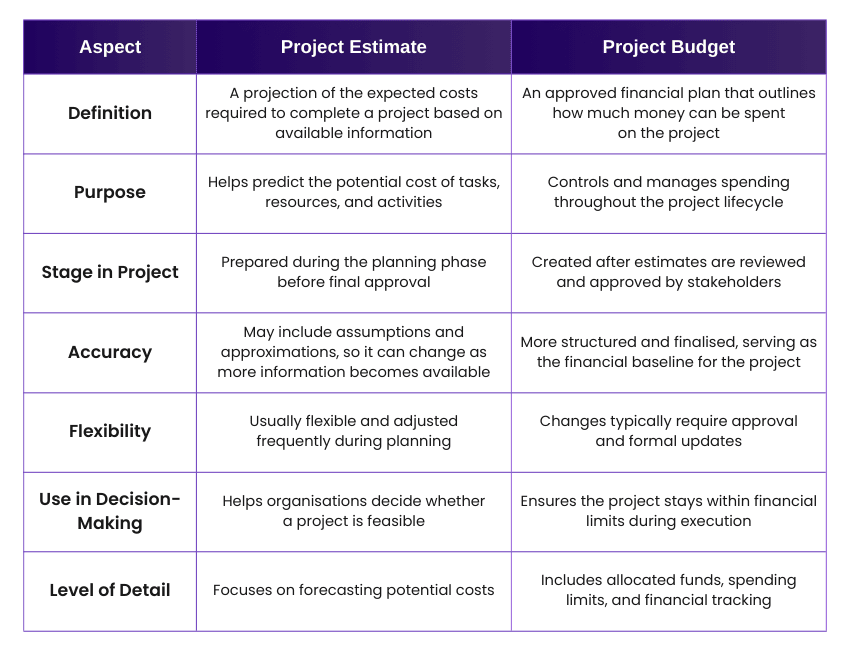
A project estimate is an early prediction of how much a project is likely to cost, created before all details are fully known. It is based on assumptions, experience and preliminary information. Since it is developed during the initial stages, an estimate often has a wider accuracy range.
In contrast, a Project Budget is the final, approved amount of money allocated to the project after estimates have been refined and validated. It serves as the financial baseline that the project team must follow during execution. The budget includes detailed cost components, such as labour, materials, overhead and contingency. Here are the key differences between them:
What are the Challenges in the Project Budget?
Although Project Budgeting is vital to successful Project Management, it often poses several challenges that can affect planning and financial control. Here are the key challenges to consider:
1) Accurate Cost Estimation:
Predicting costs accurately is difficult because it requires a clear understanding of project requirements, available resources and current market conditions.
2) Changing Project Requirements:
Business priorities or market conditions may shift during a project. This affects the scope and requiring budget adjustments.
3) Unexpected Issues and Risks:
Even with careful planning, unforeseen events can occur and disrupt the planned budget.
4) Resource Allocation Difficulties:
Distributing resources effectively while staying within budget limits can be challenging, especially when priorities compete.
5) Communication Gaps:
Poor communication among stakeholders regarding budget expectations or changes can lead to confusion, inefficiencies and financial misalignment.
Start strong and discover the fundamentals that turn ideas into thriving projects. Sign up for our
Introduction to Project Management Course
now!
Best Practices for Managing Project Budgets
Here are some proven best practices for managing Project Budgets:
1) Break Work Into Smaller Tasks:
Using tools like a Work Breakdown Structure (WBS) allows Project Managers to divide the project into manageable phases and tasks.
2) Create a Detailed Budget Plan:
A comprehensive budget should include all expected costs such as labour, materials, equipment, and overheads.
3) Use Historical Data and Expert Input:
Reviewing budgets from previous projects or consulting experts can improve the accuracy of cost estimates.
4) Include Contingency Reserves:
Setting aside a portion of the budget for unexpected expenses helps manage uncertainty and keeps the project on track if issues arise.
5) Monitor Costs Regularly:
Comparing actual spending with the planned budget helps detect problems early and allows teams to take corrective actions before costs escalate.
6) Involve Stakeholders in Budget Planning:
Collaboration with financial stakeholders ensures realistic planning.
7) Use Project Management Tools:
Budget tracking tools and Project Management software help monitor expenses, manage resources and maintain transparency across the team.
8) Update the Budget Throughout the Project:
Budgets must be reviewed and updated in real time to reflect changes, track progress, and manage financial risks effectively.
Conclusion
A well‑built Project Budget is the backbone that keeps every task, timeline and team aligned. When crafted with purpose, it destroys uncertainty and turns ideas into successful outcomes. Mastering how to define and create a Project Budget is the key to leading with confidence and delivering projects that truly make an impact.
Lead adaptable, high‑impact projects with the power of PRINCE2® and Agile. Register for our
PRINCE2 Agile® Practitioner Training
now!
Frequently Asked Questions?
Project Budgeting is the process of estimating, allocating and controlling the financial resources required to complete a project. It helps organisations plan costs, manage spending and ensure the project is delivered within approved financial limits.
A project estimate is an early prediction of the costs required to complete a project. A Project Budget, however, is the approved financial plan that sets spending limits and is used to track and control expenses during the project.
Common mistakes related to Project Budgeting include:
1) Underestimating costs
2) Ignoring hidden expenses
3) Failing to include contingency funds
4) Poor resource planning
5) Not monitoring spending regularly throughout the project