

 Back
Back


 Back to
topics
Back to
topics




Table of Contents
 25-Feb-2026
Author-Hailey Davis
Have you ever wondered who drives long-term strategy while ensuring projects are delivered successfully? This responsibility often falls between two key roles in organisations: Program Manager vs Project Manager. Understanding the difference between these roles can be challenging, as both appear similar but differ in responsibilities, focus, and organisational impact.
One role focuses on delivering specific project outcomes, while the other aligns multiple projects with strategic goals. Whether you are exploring a career in management or simply want clarity in organisational roles, understanding Program Manager vs Project Manager is essential. In this blog, you will learn about both the differences and similarities between a Program Manager and a Project Manager.
What is a Program Manager?
A Program Manager is a professional who is responsible for planning, coordinating, and guiding multiple projects to achieve organisational goals. They focus on programme strategy, success metrics, and alignment with business objectives. Also, they guide Project Managers and ensure projects follow shared frameworks, such as Agile or Scrum.
What Does a Program Manager Do?
Programme Managers oversee organisational objectives by managing multiple projects that support a larger programme. Let’s look at some of their key responsibilities below:
1) Translating C-suite goals into structured programmes that deliver strategic outcomes.
2) Reviewing projects and providing guidance to align with programme objectives.
3) Conducting audits and maintaining quality control across projects.
4) Running programmes in collaboration with Project Managers.
5) Overseeing the organisation’s strategic direction and long-term vision.
6) Balancing the needs of stakeholders and acting as the connecting link across teams.
7) Improving operational processes to strengthen programme performance.
8) Identifying and reducing risks.
9) Mentoring as well as guiding Project Managers and their teams.
Programme Managers mostly focus on the bigger picture. They think beyond the individual project completion to drive long-term organisational progress and alignment.

What is a Project Manager?
A Project Manager is a professional who is responsible for planning, organising, and delivering specific projects by managing daily tasks, timelines, and team activities. They keep teams on track, ensure clear communication, and resolve issues that affect progress. Their focus is to execute project tasks, monitor performance, support team members, and ensure deliverables are completed.
What Does a Project Manager Do?
Project Managers focus on executing projects by turning strategic goals into practical actions. Let's look at some of their key responsibilities below:
1) Turning programme goals into clear, actionable project plans.
2) Assembling and leading teams to achieve project objectives.
3) Delegating tasks effectively based on team strengths.
4) Creating and managing project budgets.
5) Identifying and mitigating potential risks proactively.
6) Keeping teams aligned through clear and consistent communication
Project Managers ensure that every project runs seamlessly and delivers the expected results on time and within the established scope margins.
Program Manager and Project Manager: Key Differences
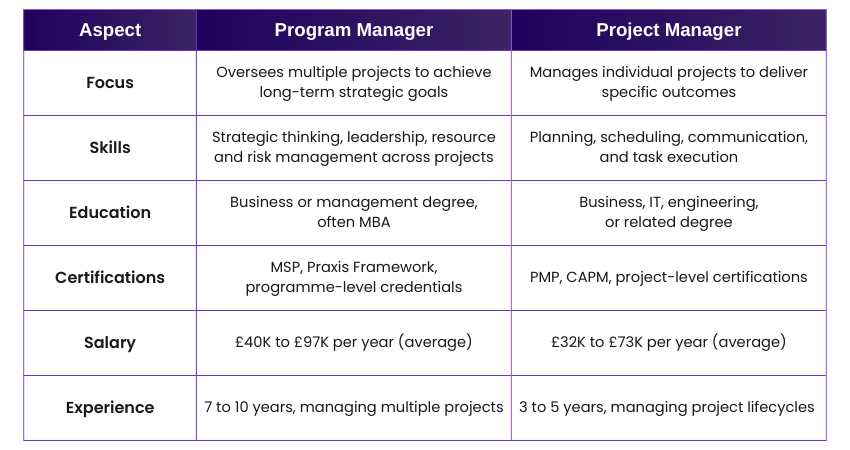
Now that you understand what each role involves, let’s look at how they differ. Recognising these differences will bring clearer insight into Program Manager vs Project Manager. Let’s examine the key differences below:
1) Job Description
Program Managers look after multiple related projects or even entire programmes that support long-term organisational goals. They focus on strategy, resource alignment, and ensure that different projects work together to deliver business value. Generally, their work is complex, long-term, and based on high-level decision-making.
Project Managers focus on delivering specific projects within defined timelines and budgets. They plan, execute, and complete projects while coordinating teams, managing tasks, and ensuring deliverables meet requirements. Their work is operational and time-bound, primarily focusing on achieving clearly defined project outcomes.
2) Skills
Program Managers require strong strategic thinking and leadership skills since they are responsible for overseeing several projects simultaneously. They manage resources, balance stakeholder expectations, and manage programme-level risks. Their role demands the ability to see the bigger picture and guide teams towards long-term organisational success.
Project Managers need strong organisational and execution-focused skills to manage daily project activities. They must schedule tasks, communicate clearly with stakeholders, negotiate priorities, and ensure deadlines are met. Their skills are centred on planning, coordination, and delivering results efficiently.
3) Education
Generally, Program Managers hold a bachelor’s degree in business or management, and many pursue advanced qualifications such as a Master of Business Administration (MBA). Their education often emphasises strategic planning, leadership, and organisational management to support programme-level decision-making.
Project Managers have a bachelor’s degree in business, management, IT, engineering, or another relevant discipline. Their education focuses on communication, planning, and operational management. This provides them with the foundation required to lead project teams and manage project delivery.
Build strong Project Management fundamentals today with the
PRINCE2® Foundation Training
– Sign up now!
4) Certifications
Program Managers pursue certifications that focus on managing complex programmes and aligning initiatives with organisational strategy. Some common certifications include Praxis Framework™ Foundation and Practitioner and Managing Successful Programmes (MSP). These certifications demonstrate expertise in managing interconnected projects and delivering strategic value.
Project Managers pursue certifications focused on project planning and execution. Popular options include Project Management Professional (PMP) and Certified Associate in Project Management (CAPM). These certifications validate skills in managing project lifecycles, coordinating teams, and applying different project management methodologies.
5) Salary
Entry-level Program Managers earn lower salaries, while experienced Program Managers receive significantly higher compensation due to their role in managing large initiatives and driving organisational outcomes. On average, they earn between £40K - £97K per year.
Project Manager salaries vary depending on experience, industry, and project complexity. Entry-level Project Managers earn moderate salaries, while experienced Project Managers earn higher pay for delivering complex projects. On average, they earn between £32K - £73K per year.
6) Experience
Program Managers require extensive experience, often ranging from seven to ten years in project or portfolio management roles. They need to have a proven track record of managing multiple interdependent projects, handling stakeholders, and making strategic decisions.
Project Managers need fewer years of experience, often around three to five years in project coordination or management roles. They must understand project lifecycles, scheduling, budgeting, and stakeholder communication, along with gaining certifications to demonstrate their expertise.
Turn knowledge into practical project success and lead complex projects confidently with the
PRINCE2® Practitioner Training
– Sign up now!
The Similarities Between a Program Manager and Project Manager
Responsibilities for a Program Manager share important qualities that help them manage projects successfully. Understanding the similarities alongside the differences provides more clarity on Program Manager vs Project Manager.
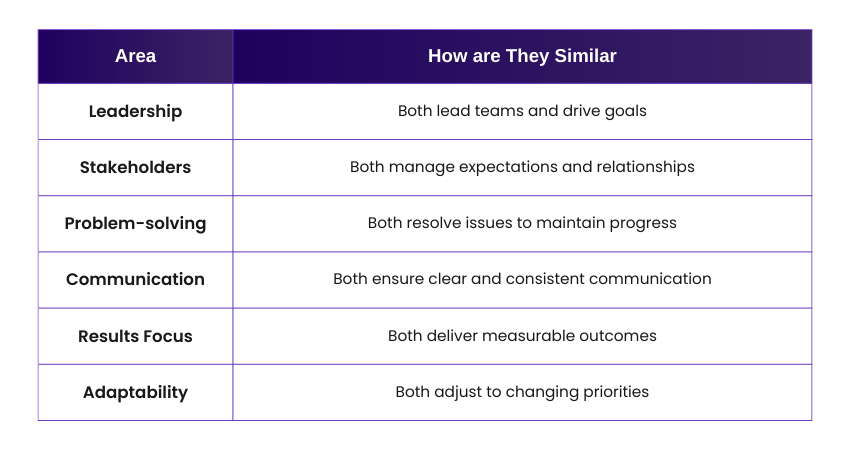
Even when analysing Programme Manager vs Project Manager, recognising their shared leadership capabilities helps organisations understand how both roles contribute to successful outcomes. Let’s look at them below:
1) Leadership and Management
Program Managers and Project Managers are strong leaders who guide teams towards shared goals. They make important decisions, coordinate activities, and ensure work is completed effectively. For both roles, it is central to motivate team members, encourage collaboration, and maintain accountability.
2) Stakeholder Engagement
Both roles work closely with stakeholders throughout the lifecycle of a project. They manage expectations, communicate progress, and ensure alignment with organisational objectives. For them, building strong relationships and maintaining regular communication are essential for successful outcomes.
3) Problem-solving
Program Managers and Project Managers face challenges that require quick thinking and sound judgement. They analyse complex situations, evaluate possible solutions, and take action to keep work on track. Their ability to resolve issues effectively supports smooth execution and sustains long-term success.
4) Communication Skills
Clear and effective communication is critical for both the Program Manager and the Project Manager. They must share updates, explain decisions, and coordinate with teams, stakeholders, and senior leadership. Both roles require strong listening skills and the ability to adapt to different communication styles.
5) Result-oriented
Program Managers and Project Managers focus on delivering successful outcomes. Whether managing a single project or multiple initiatives, both roles prioritise quality, performance, and measurable results. Their work is driven by achieving defined goals and creating real value for the organisation.
6) Adaptability
Program Manager and Project Manager operate in dynamic environments where priorities and circumstances frequently change. Both must remain flexible, adjust plans when needed, and manage uncertainty. Adaptability helps them respond to challenges and maintain progress even in constantly changing conditions.
Conclusion
Understanding Program Manager vs Project Manager helps you see how organisations turn strategy into real results. While Program Managers focus on long-term, direction and alignment across multiple projects, Project Managers ensure individual projects are delivered successfully. Both roles are highly important to drive progress from a vision to practical execution.
Build project leadership skills that deliver results with
PRINCE2® Certification
– Sign up now!
Frequently Asked Questions?
Yes, a Program Manager is higher in the organisational hierarchy than a Project Manager. While Project Managers focus on delivering individual projects and managing daily execution, Program Managers oversee multiple related projects, align them with strategic goals, and manage high-level resources.
Yes, a Program Manager role is considered a promotion from a Project Manager. It marks a shift from managing the daily execution of a single project to overseeing multiple projects. Project Managers deliver outcomes, while Program Managers drive overall business impact.
The core difference between a Project Management Office (PMO) and a Project Manager (PM) is their scope and focus. A Project Manager handles the daily execution of a single project, while PMO provides strategic oversight, governance, and standardised processes to manage and support every project across the organisation.