

 Back
Back


 Back to
topics
Back to
topics



Table of Contents
 06-Feb-2026
Author-James Smith
Projects often fail not due to poor ideas but due to weak control, unclear roles, and unjustified decisions. This is where the PRINCE2 Themes make the real difference. They act as guiding pillars that help teams stay organised, manage risk effectively, and keep projects aligned with clear business objectives.
Understanding these themes is essential for anyone involved in Project Management. Whether you are a beginner or an experienced professional, these themes ensure progress is monitored and quality is maintained. In this blog, you will learn about the PRINCE2 Themes, their importance, and their roles. Keep reading to learn more!
What is PRINCE2?
PRINCE2 (PRojects IN Controlled Environments) is a widely recognised Project Management methodology that provides a structured framework for managing projects. Originating in the UK, it is used globally and is valued for its strong focus on organisation, control, and quality throughout the project lifecycle.
The PRINCE2 methodology places strong emphasis on clear roles and responsibilities, effective communication, and ongoing evaluation and improvement. Its flexible and scalable nature allows it to be tailored to different project needs, helping organisations achieve successful business outcomes.

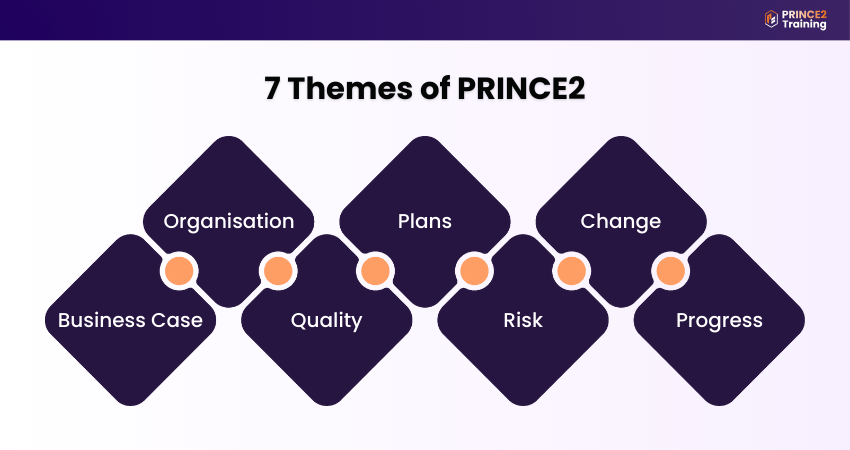
The 7 Core Themes of PRINCE2
Let’s look at the 7 PRINCE2 Themes that explain how a project should be managed by focusing on areas that must be addressed continuously throughout the project lifecycle:
1) Business Case
The Business Case theme in PRINCE2 ensures that the project remains a worthwhile investment. It supports the principle of “continued business justification” by helping decision-makers assess if the project delivers value compared to its costs and risks. Here, the business case is reviewed at each stage to confirm that continued investment is justified.
In PRINCE2, both customer and supplier may rely on a business case to justify their involvement. The executive owns the business case and is responsible for stopping the project if it no longer provides value.
Key Requirements:
1) Every project must have a documented business case.
2) The business case must be reviewed and updated throughout the project.
3) Management actions must ensure outcomes are achieved and benefits are realised.
2) Organisation
The Organisation theme in PRINCE2 defines a clear Project Management structure, ensuring everyone understands their responsibilities and accountabilities. PRINCE2 works in a customer-supplier environment, with overall direction by the project board.
The project board includes the executive, senior user, and senior supplier. Supports roles, such as the Project Manager, team managers, project support, and more, ensure effective delivery, independent assurance, and seamless communication across stakeholders.
Key Requirements:
1) All PRINCE2 roles and responsibilities must be fulfilled.
2) A communication management approach must be documented.
3) Stakeholder engagement and information must be clearly defined.
3) Quality
The Quality theme in PRINCE2 ensures every project product is fit for purpose and meets defined requirements. Quality expectations, acceptance criteria, and quality control methods are agreed upon proactively and documented in a quality management approach to maintain consistency through the project lifecycle.
Quality assurance operates outside the project to ensure compliance with organisational standards. Quality control activities, approvals, and test results are recorded in a quality register. After it is approved, products become baselined and are subjected to formal change control.
Key Requirements:
1) A quality management approach must be created and maintained.
2) Clear quality criteria and acceptance criteria must be defined.
3) Quality activities must be recorded in a quality register.
4) Lessons learned must inform quality planning.
4) Plans
The Plans theme in PRINCE2 focuses on defining how, when, by whom, and at what cost the project’s products will be delivered. PRINCE2 uses three levels of plans: the project plan, stage plans, and team plans, each serving a different management level.
Product-based planning is central to this theme, ensuring clarity on deliverables and dependencies. Plans include budgets for delivery, risks, and approved changes. Here, exception plans are created when tolerances are forecast to be exceeded, with supportive, effective control and escalation.
Key Requirements:
1) Plans must support the delivery of the business case.
2) A minimum of two management steps is required.
3) Project, stage and exception plans must be maintained.
4) Product-based planning must be executed.
Apply PRINCE2 in real projects and improve your decision-making skills with
PRINCE2® Practitioner Training
– Join now!
5) Risk
The Risk theme in PRINCE2 provides a structured approach to identifying, assessing, and managing uncertainty. A risk can be a threat or an opportunity, and it is important to distinguish risks from issues, which are events that have already occurred.
Risks are recorded in a risk register and managed using a defined risk management approach. This involves identifying risks, assessing likelihood and impact, planning responses, implementing actions, and communicating status. This helps control exposure and support informed decision-making.
Key Requirements:
1) A risk management approach must be defined.
2) Roles and responsibilities must be assigned.
3) A risk register must be established and maintained.
4) Lessons learned must inform risk identification and their responses.
6) Change
The Change theme in PRINCE2 ensures every change to baselined products is identified, assessed, and controlled. Once a product is approved and baselined, it cannot be changed without following formal change control procedures.
Project issues, such as requests for change, off-specifications, and problems are captured and assessed for their impact on time, cost, quality, scope, benefits, and risk. Decisions are made by the change of authority or project board, and are funded through a change budget, ensuring value for money.
Key Requirements:
1) A change control approach must be defined.
2) Product baselines must be created, maintained, and controlled.
3) All issues must be documented and managed.
4) An issue register needs to be maintained.
7) Progress
The Progress theme in PRINCE2 establishes how performance is measured against planned performance. It enables management by stages and management by exception through the use of tolerances at project, stage, and work package levels.
Progress is monitored using time-driven controls, such as reports, and event-driven controls, like exception reports. Baselines, registers, and reports provide visibility into performance, forecasts, and lessons learned. This theme ensures timely escalation, informed decisions, and continuous review of the project’s business justification.
Key Requirements:
1) The project’s progress control approach must be defined.
2) Management by stages and by exception must be applied.
3) Tolerances must be set and monitored.
4) Business justification must be reviewed when exceptions occur.
Build structured Project Management skills with
PRINCE2® Certification
– Join now!
Why is PRINCE2 Important?
PRINCE2 is important because it provides a proven structured way to manage projects while maintaining strong control over resources, risks, and business objectives. Let's look at some important reasons why it is important below:
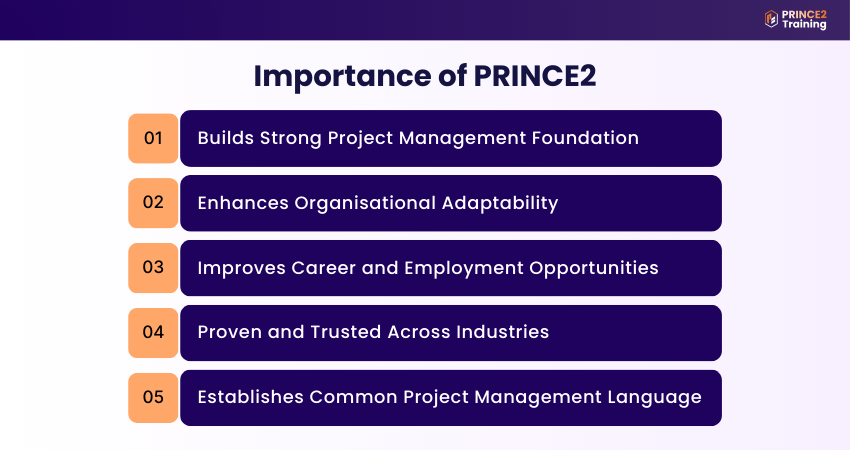
1) Builds Strong Project Management Foundation
PRINCE2 provides a solid foundation for Project Management by introducing clear roles and structured processes. This structured approach helps professionals understand how projects are initiated, planned, controlled, and delivered. By improving control over resources and risks, PRINCE2 helps beginners build confidence and core Project Management skills.
2) Enhances Organisational Adaptability
PRINCE2 is highly adaptable and can be tailored to suit different organisations, industries, and delivery approaches. As professionals gain experience, they can customise the methodology to match their organisational needs, creating a practical and flexible Project Management approach.
3) Improves Career and Employment Opportunities
A PRINCE2 certification is a valuable addition to any professional profile. With over a million certified professionals globally, PRINCE2 is one of the most widely utilised Project Management methodologies. Many organisations seek PRINCE2-certified professionals, making it a strong advantage for career growth.
4) Proven and Trusted Across Industries
PRINCE2 is based on real-world experience and practical application across multiple industries. It is supported by extensive case studies that demonstrate its effectiveness in managing projects successfully, making it more than just a theoretical framework.
5) Establishes Common Project Management Language
PRINCE2 creates a mutual understanding across project teams by using consistent terminology and concepts. This common language ensures that Project Managers, team members, and stakeholders interpret key terms, leading to clearer communication and smoother project execution.
Learn the fundamentals of Project Management with
PRINCE2® Foundation Training
– Register now!
Various Roles Defined in PRINCE2
PRINCE2 methodology is built around clearly defined roles and responsibilities. Let’s look at the key roles that ensure effective governance, accountability, and control throughout the project below:
1) Executive
The Executive is responsible for the overall success of the project and secures the funding needed to deliver it. This role owns and maintains the business case, ensuring the project remains justified, and appoints the project board and Project Management team.
2) Senior User
The Senior User represents those who will use or be affected by the project’s outputs. This role ensures user needs are clearly defined and prioritised within the project. They are also responsible for specifying and realising the project’s expected benefits.
3) Senior Supplier
The Senior Supplier represents those who design, build, and deliver the project's products. This includes internal teams, external suppliers, and support providers. The role ensures that solutions are feasible, resourced, and meet required quality standards.
4) Project Manager
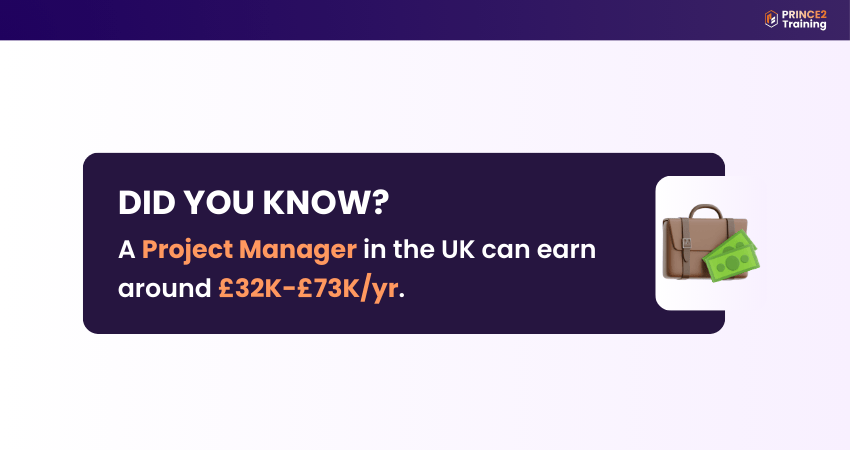
The Project Manager handles the everyday responsibilities of a project. They plan, monitor, and control progress while managing budgets, schedules, risks, and issues. Regular communication with the project board and stakeholder is one of their primary responsibilities.
5) Team Manager
The Team Manager is responsible for delivering specialist products on a daily basis. They manage technical work and create work packages assigned to team members. Completed work packages collectively form a management stage.
6) Project Assurance
Project Assurance provides independent checks on project performance and controls. This role ensures business, user, and supplier interests are properly represented. It must remain independent of the Project Manager to maintain objectivity.
Conclusion
Understanding the PRINCE2 Themes is key to managing projects with confidence and clarity. Each theme works together to ensure strong business justification, clear roles, effective planning, and continuous monitoring. This helps organisations to reduce risks, improve decision-making, and adapt to change without losing project control. Learning these themes provides a solid foundation for delivering successful and well-governed projects consistently.
Combine PRINCE2 with Agile flexibility to deliver projects effectively with
PRINCE2 Agile® Foundation and Practitioner Training
– Join now!
Frequently Asked Questions?
PMP is generally considered more challenging than PRINCE2 because it covers a broader scope based on the PMBOK Guide and focuses heavily on situational, scenario-based questions. It also expects candidates to demonstrate substantial real-world project experience, making the exam more demanding overall.
Yes, PRINCE2 can help increase salary by improving career credibility and job opportunities. Certified professionals are often considered for higher-paying roles due to their structured Project Management skills. Many see gradual pay growth as they gain experience and apply PRINCE2 in real projects.
The big three or the Triple Constraint in Project Management are:
1) Scope: Defines what needs to be delivered, such as goals, requirements, and outputs.
2) Time: Focuses on schedule, deadlines, and project duration.
3) Cost: Covers the budget and resources required to complete the project.