

 Back
Back


 Back to
topics
Back to
topics




Table of Contents
 02-Dec-2026
Author-Maria Thompson
In every successful project, clarity plays a critical role, and PRINCE2® delivers this through its well-defined roles and responsibilities. This structured approach ensures that every contributor understands their purpose and how their actions influence the project’s overall outcome, regardless of its complexity.
From decision-makers to day-to-day delivery roles, PRINCE2® Roles and Responsibilities create a clear governance structure where collaboration improves and uncertainty is minimised. In this blog, we explain each role to help your projects operate with greater control, confidence, and consistency. Read on to learn more!
Key Roles in a PRINCE2® Project
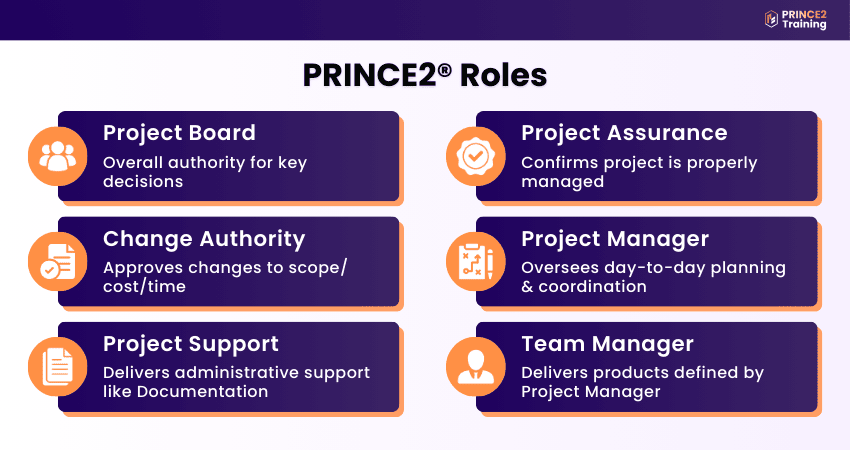
The PRINCE2® methodology is built around clearly defined management stages to support proper project delivery. These are supported by clearly defined roles, including the following:
1) Project Board
The Project Board is responsible for the overall success of the project. It represents the business, user, and supplier interests that support the project. The Board makes key decisions to keep the project aligned with agreed goals, budgets, and expectations. It also acts as the link between the Project Manager and senior stakeholders.

2) Project Assurance
Project Assurance provides confidence to the key stakeholder interests, business, user, and supplier that the project is being managed appropriately. To stay objective, Project Assurance must remain independent of the Project Manager. For this reason, assurance responsibilities cannot be assigned to the Project Manager. They verify that appropriate and competent individuals create product descriptions.
3) Change Authority
The Project Board may delegate responsibility for approving change requests and off-specifications to an individual or group called the Change Authority. In certain situations, the Project Manager can take on this role for specific changes. This is only allowed when the changes stay within agreed limits and do not affect management stage tolerances.
4) Project Manager
The Project Manager reports to the Project Board, and ultimately to the Executive, and is authorised to manage the project on a day-to-day basis within the limits they have defined. Their primary responsibility is to deliver the required outputs within agreed tolerances for time, cost, quality, scope, benefits and risk. The Project Manager also makes sure that the project’s outputs are aligned with the business case and positioned to realise the intended benefits.
5) Project Support
Formal Project Support is optional and may be set up as a dedicated role or function. Where no separate support role exists, these responsibilities are carried out by the Project Manager. One key support activity to consider is change control.
Depending on the project’s size and complexity, this may need to be formalised, as managing changes can become too demanding for the Project Manager without additional assistance. Project support can be provided by a project office or by specifically assigned resources.
6) Team Manager
The Team Manager is responsible for delivering the products defined by the Project Manager, ensuring they meet agreed quality standards, are completed within the specified timescales, and are produced at a cost acceptable to the Project Board.
The Team Manager works under the direction of, and reports directly to, the Project Manager. As part of this role, the Team Manager prepares detailed team plans for approval and provides regular checkpoint reports to keep the Project Manager informed of progress and issues.
Blend agility with proven project governance in our
PRINCE2 Agile® Foundation Training
- Register now!
Responsibilities Within PRINCE2® Roles
Each PRINCE2® role carries clearly defined responsibilities that collectively support project control and successful delivery. These PRINCE2® Roles and Responsibilities are defined in the methodology as guidance and can be tailored to suit the project’s size and complexity. Below are the responsibilities for each role:
1) Project Manager
The Project Manager is responsible for developing and maintaining the project plan and overseeing its execution throughout the project lifecycle. This role involves identifying and mitigating risks and issues as they arise, while maintaining control over progress without becoming overly focused on minor details. Proper communication with stakeholders is also a key responsibility, which ensures transparency and alignment at all stages.
2) Project Board
The Project Board provides the overall direction of the project. It's responsible for making key decisions that affect the project’s outcome. They ensure that project objectives remain aligned with organisational goals and approve significant changes when required. The Board also addresses major issues, risks or conflicts that may arise during the project.
3) Team Manager
The Team Manager coordinates the team's work to make sure the tasks are delivered in line with agreed plans. This includes monitoring the team performance, ensuring activities are completed on time and building accountability within the team. Regular progress updates are relayed to the Project Manager to support effective monitoring and control.
4) Project Assurance
Project Assurance makes sure that the project is being managed and delivered correctly in line with agreed standards and expectations. This role independently reviews the progress and deliverables to confirm that they meet defined requirements and reports findings directly to the Project Board. It also highlights any corrective actions required to address issues or deviations.
5) Project Support
Project Support assists the Project Manager and project team with administrative and coordination activities. Responsibilities include supporting planning and scheduling activities, maintaining project documents and records, and managing project information and communication to ensure smooth and efficient project operations.
The combo of PRINCE2® and Agile can help you lead hybrid projects with confidence. Sign up for our
PRINCE2 Agile® Practitioner Training
now!
What are the Management Stages in PRINCE2
In PRINCE2®, projects are divided into distinct management stages to provide structured control and clear authorisation stages throughout the project lifecycle. This staged approach ensures that planning, monitoring, and controlling are carried out systematically. Here are the key points to remember:
1) Minimum Structure:
Every PRINCE2® project must have at least two management stages. These include the Initiation Stage for planning and at least one further stage to carry out the project work.
2) Initiation Stage:
This is the first management stage. It focuses on defining project objectives, documenting the Business Case, and creating detailed plans for how the project will be managed.
3) Execution Stages:
After initiation, one or more stages are used to deliver the project products. These stages focus on carrying out the work, managing risks, and applying agreed controls.
4) Management Stage Boundaries:
At the end of each stage, a stage boundary is reached where progress and performance are reviewed by the Project Board.
5) Decision Point:
Each stage boundary acts as a decision gate where the Project Board evaluates the Business Case and decides whether to approve the next stage, change direction, or stop the project.
Conclusion
PRINCE2® is built on clarity. When PRINCE2® Roles and Responsibilities are clearly defined, projects are managed with greater control and direction. Understanding who is responsible for decision-making, delivery, and assurance helps teams work more effectively and keeps risks visible. As a result, outcomes remain aligned with business goals, supporting consistent and successful project delivery.
Open doors to global project opportunities with our range of
PRINCE2® Certification
- Sign up now!
Frequently Asked Questions?
No FAQs available