

 Back
Back


 Back to
topics
Back to
topics




Table of Contents

 21-Jan-2026
Author-David Walter
Projects tend to fail due to unclear roles, poor planning, or weak control. That is why many organisations rely on PRINCE2® to bring structure and consistency to their project work. That’s where understanding PRINCE2® Advantages and Disadvantages becomes especially valuable, as it helps teams understand how the method supports stronger planning, clearer responsibilities, and improved control across every project stage.
Exploring the PRINCE2® Advantages and Disadvantages gives organisations a balanced view so they can judge when PRINCE2® adds value and when a simpler approach is more appropriate. Keep reading to explore the topic more clearly.
What is PRINCE2® Methodology?
PRINCE2® Methodology is a structured Project Management approach that helps teams plan, manage, and deliver projects with clarity and control. It defines clear roles and responsibilities, supports detailed planning, and encourages regular progress reviews to keep work on track. By dividing projects into manageable stages, PRINCE2® supports effective risk management, performance monitoring, and informed decision-making throughout the project.
PRINCE2® is widely adopted across industries because it can be adapted to suit projects of different sizes and complexity. Its strong focus on the business case ensures that projects remain justified and continue to deliver value. Overall, the method supports better governance, stronger control, and improved project outcomes.

Advantages of PRINCE2® Methodology
Understanding PRINCE2® Advantages and Disadvantages can help organisations decide when to use PRINCE2® effectively. Let’s look at the advantages that PRINCE2® methodology has to offer:
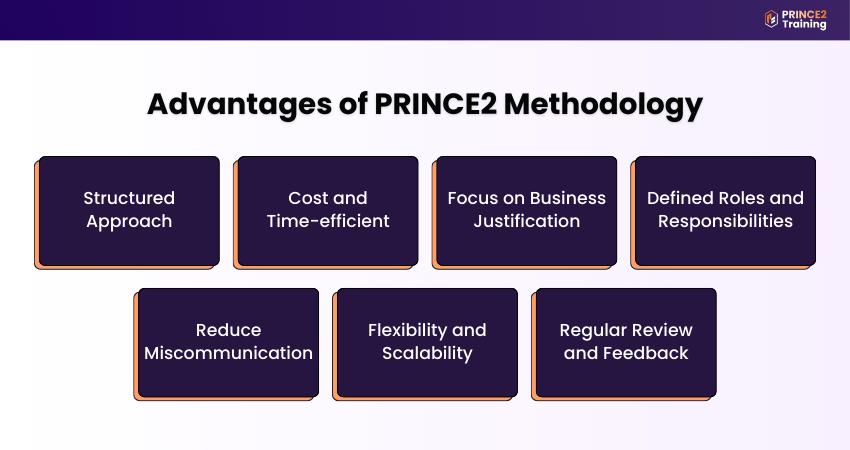
1) Structured Approach
PRINCE2® provides a clear and well-defined structure for managing projects. It breaks down work into manageable steps. This makes planning, monitoring, and reviewing progress easier. This approach helps Project Managers to control complex project processes and workflows.
2) Cost and Time-efficient
PRINCE2® promotes standardised processes, making it simpler and cost-effective to train staff familiar with this method. Also, this encourages focused communication and streamlined meetings, helping teams to save both time and money.
3) Focus on Business Justification
One of PRINCE2’s core strengths is its strong focus on the business case. Every project has a clear reason and justification to move forward. This ensures projects remain aligned with organisational goals and continue to deliver value without wasting time and resources.
4) Defined Roles and Responsibilities
PRINCE2® clearly defines roles and responsibilities for every team member. This reduces confusion, improves communication, and increases accountability. This helps teams to perform efficiently and improve project outcomes.
5) Reduce Miscommunication
With clear roles, documented plans, and regular reviews, it eliminates miscommunication. PRINCE2® ensures that information is consistently shared, decisions are transparent, and stakeholders are informed throughout the project lifecycle.
6) Flexibility and Scalability
PRINCE2® can be tailored to fit the needs of projects of any size and complexity. While it is well-suited for large, complex projects, its principles can be adapted to organisational needs, making it highly flexible.
7) Regular Review and Feedback
PRINCE2® includes review points at the end of each project stage. This enables teams to assess performance and efficiency, address issues proactively, and make timely improvements. This helps to increase the project’s success and drive better business outcomes.
Advance your Project Leadership skills with
PRINCE2® Practitioner Training
– Register today!
Disadvantages of PRINCE2® Methodology
Let’s look at the key limitations of the PRINCE2® methodology below:
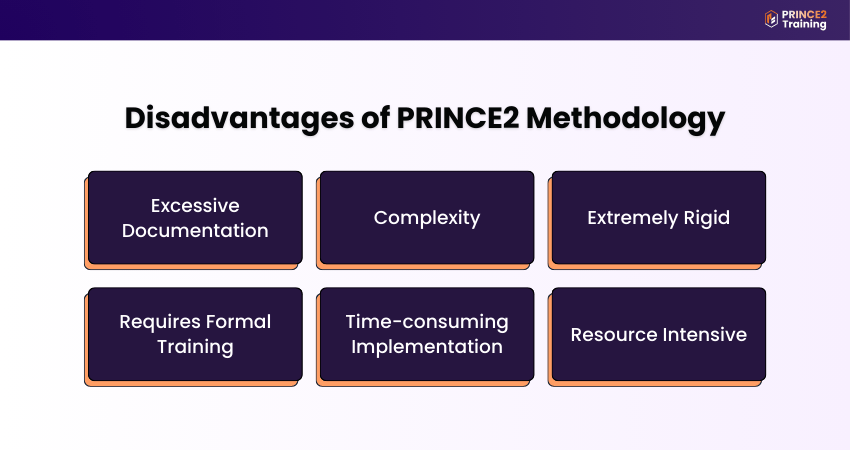
1) Excessive Documentation
PRINCE2® requires a high level of documentation throughout the project lifecycle. While this supports control, it can slow down progress. Teams that prefer execution over paperwork may find this requirement challenging.
2) Complexity
PRINCE2® methodology can be complex, especially for beginners. Understanding its principles, themes, and processes takes time, training, and experience. Without building a strong foundation, teams will struggle to adapt effectively.
3) Extremely Rigid
PRINCE2® follows fixed project stages that projects must adhere to. Although it brings consistency and control, it can be restrictive. Compared to other flexible approaches, PRINCE2® may not adapt quickly to organisational transitions or evolving requirements.
4) Requires Formal Training
PRINCE2® is difficult to use without any proper, formal training. Teams require experienced practitioners to manage these stages and products correctly. Without having the expertise, applying the PRINCE2® methodology can become useless.
Start your Project Management journey with core knowledge and a solid foundation with
PRINCE2® Foundation Training
– Register today!
5) Time-consuming Implementation
It takes time to adopt the PRINCE2® Methodology, especially for small-sized organisations or those who are using it for the first time. The need to train staff, set up processes, and tailor the method to project needs can delay project start-up and slow down progress.
6) Resource Intensive
PRINCE2® is dependent on the skills and practical expertise of people as well as the availability of adequate resources. Smaller organisations with limited budgets and staff may find it challenging to implement the methodology to its full potential.
Conclusion
PRINCE2® offers a clear framework, strong control, and reliable structure for managing projects, but it is not a one-size-fits-all solution. Its detailed processes work best when projects require governance, clear roles, and formal oversight. Understanding the PRINCE2® Advantages and Disadvantages clearly helps you decide whether PRINCE2® supports your organisational goals or another flexible approach is suitable.
Build strong project control skills and lead projects to successful business outcomes with
PRINCE2® Certification
– Register today!
Frequently Asked Questions?
To remember the seven PRINCE2® processes, use a mnemonic like “Start Initiating Direct Control, Manage Stage, Close” for: Starting Up, Initiating, Directing, Controlling, Managing Product Delivery, Managing Stage Boundary, and Closing.
Here are the seven principles of PRINCE2:
1) Continued Business Justification
2) Learn from Experience
3) Defined Roles and Responsibilities
4) Manage by Stages
5) Manage by Exception
6) Focus on Products
7) Tailor to Suit the Project
Yes, PRINCE2® is worth having if you work in project management or aspire to. It’s globally recognised, provides a structured framework, and improves project success rates. It’s especially valuable for large, complex projects and organisations seeking consistency and control.