

 Back
Back


 Back to
topics
Back to
topics




Table of Contents
 07-Feb-2026
Author-Maria Thompson
Management by Exception functions like a spotlight in the world of business, as it quietly scans the workflow until it catches something unusual. Instead of drowning leaders in endless details, this approach highlights only what truly needs attention. It’s efficient, sharp, and surprisingly empowering.
However, like any management style, it carries both impressive strengths and hidden pitfalls. In this blog, we’ll unravel the advantages and disadvantages of Management by Exception, helping you decide whether this selective focus can elevate your team’s performance. So read on!
What is Management by Exception?
Management by Exception is a management approach that concentrates attention on those areas that fall outside normal or acceptable limits. Rather than monitoring everything equally, it directs effort towards products or processes that demand urgent intervention, while allowing stable operations to continue uninterrupted.
Within Inventory Management, this method challenges the practice of treating every item the same. Overseeing thousands of products with equal intensity is inefficient and resource-heavy, increasing the risk of misdirected effort, operational strain and avoidable financial losses.

How Management by Exception Works?
Management by Exception follows a structured four-step process. Here are the key steps:
1) Defining Objectives and Standards:
Clear objectives are established, along with defined standards that outline how the business is expected to operate. These benchmarks create a reference point for normal performance.
2) Monitoring Performance:
Performance is continuously assessed to identify strengths, highlight weaknesses, and ensure activities remain aligned with set objectives. This ongoing evaluation helps maintain control without unnecessary oversight.
3) Identifying Deviations:
This step involves reviewing work outputs and records in detail to pinpoint areas where results diverge from expectations. This analysis reveals exceptions that require attention.
4) Addressing Exceptions:
The final step involves investigating and resolving identified exceptions. While this stage may appear straightforward, it demands a well-planned strategy to ensure corrective actions are effective and sustainable.
Components of Management by Exception
Here are the six core elements that form the Management by Exception principle:
1) Measurement:
This involves tracking past and current performance levels to identify any results that fall outside acceptable limits.
2) Projection:
Key business activities are forecasted to ensure alignment with organisational objectives. This step helps set clear expectations for future performance.
3) Selection:
Management defines the critical parameters and benchmarks used to evaluate progress towards business goals.
4) Observation:
Ongoing monitoring of operational performance provides visibility across all areas of the organisation.
5) Comparison:
Actual results are measured against planned targets to highlight variances. These differences signal exceptions that require management attention and action.
6) Decision-making:
Informed decisions are taken to correct deviations and improve performance. Adjustments reflect changing business conditions and revised expectations.
Become a champion project Strategist with
PRINCE2® Practitioner Training
– register now!
How to Implement Management by Exception?
To adopt Management by Exception as a leadership approach, organisations generally follow these key steps:
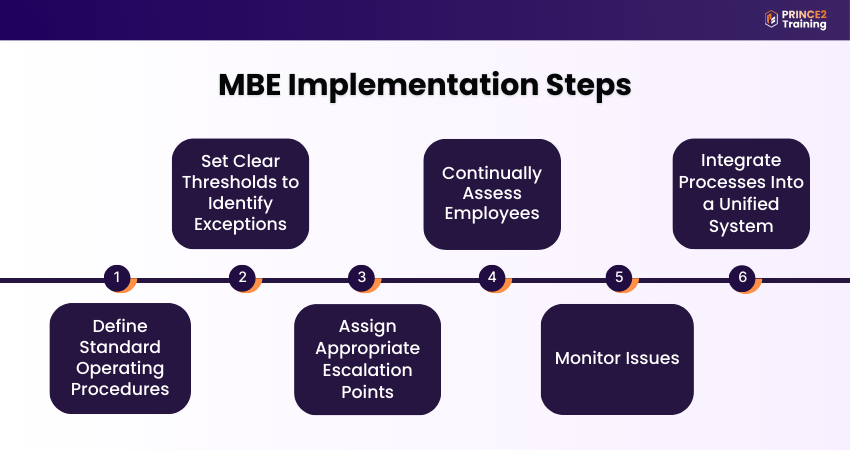
1) Define Standard Operating Procedures
Begin by clearly outlining normal operating procedures so that employees understand what is expected in routine situations. Set expectations on weekly, monthly, quarterly and annual cycles. Clear norms make it easier to recognise when something falls outside the usual pattern. An exception may also arise when an expected activity fails to occur, such as a key client missing a regular meeting.
2) Set Clear Thresholds to Identify Exceptions
MBE is most effective when exceptions are precisely defined. This approach suits data-driven environments, which explains its widespread use in sectors such as Finance and Accounting. Limits can be set in various ways, including acceptable percentage variances in performance, costs or account values.
3) Assign Appropriate Escalation Points
Defined points of contact help manage issues efficiently, especially in larger organisations. Minor concerns can be handled independently, while more complex matters are escalated to mid-level Managers, and critical issues are escalated to senior leadership.
4) Continually Assess Employees
Although MBE encourages autonomy, ongoing performance assessment remains a key step. The approach relies on employees being able to resolve issues independently, which may not be true for everyone initially. Regular reviews help confirm that KPIs are being met and that problems are being managed effectively, particularly during onboarding. As competence increases, monitoring can become less intensive.
5) Monitor Issues
To measure the effectiveness of MBE, organisations should regularly review how both routine issues and exceptions are handled. Comparing outcomes with previous management approaches helps determine overall effectiveness. Results may take time to emerge as employees adapt to greater responsibility and Managers refine how they allocate their attention.
6) Integrate Processes Into a Unified System
MBE delivers results only when all elements function together as a structured system. Employees must be equipped with the knowledge and tools to assess and resolve issues independently, while Managers need visibility to ensure no exceptions are overlooked. When properly integrated, MBE becomes a highly efficient management approach.
Make every project remarkable with a comprehensive range of
PRINCE2® Certification
- Sign up now!
Key Criteria to Consider in Exception Management
Good Exception Management depends on accurate product classification. Proper classification helps develop targeted strategies for different product groups. Here are the criteria to consider:
1) Product Life Cycle Stage
Every product progresses through distinct lifecycle stages, each requiring a different management approach:
1) Launch Phase:
This stage is characterised by uncertain demand. The priority is Risk Management and supporting a smooth entry into the market.
2) Maturity Phase:
As the most stable stage, maturity offers the greatest scope for optimisation. Management focuses on improving efficiency and achieving consistent operational performance.
3) Decline Phase:
Here, demand begins to fall, and the risk of obsolescence rises. Strategies centre on controlled stock reduction, targeted promotions, and preventing excess inventory.
2) Product Profitability
Comparing revenue against the associated costs for each product provides valuable insight. Highly profitable items often operate with lower relative costs, while less profitable products can consume disproportionate resources. This analysis highlights where management attention should be concentrated to improve overall efficiency.
3) Cross ABC Classification
ABC analysis is a common inventory tool, but combining it with factors such as sales volume, margins or turnover creates a more precise classification. This approach clearly identifies strategically important products and supports more focused decision-making.
For instance, a product rated “A” for sales but “C” for turnover requires a different strategy than one ranked “A” across both measures.
Advantages of Management by Exception
There are many potential benefits to using MBE when a competent team implements it. Some of these pros include:
1) Promotes Efficiency
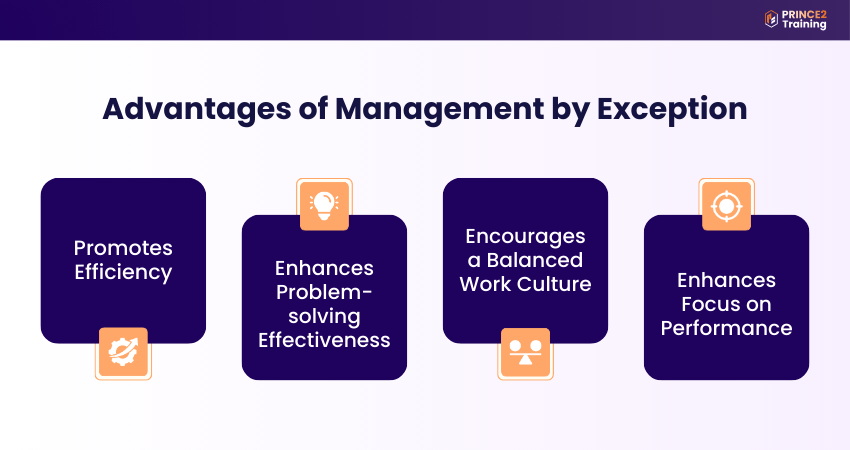
By allowing effective delegation, MBE makes sure that the tasks are handled by those best suited to them. Managers can concentrate on strategic priorities, while employees manage day-to-day operations, thus improving overall organisational productivity.
2) Enhances Problem-solving Effectiveness
Management by Exception supports proper problem resolution by empowering employees to handle issues within their capabilities. This reduces unnecessary escalation and allows the Managers to dedicate time and resources to more complex challenges.
3) Encourages a Balanced Work Culture
MBE promotes a balanced level of autonomy by reducing micromanagement and encouraging ownership. As employees assume greater responsibility, motivation increases, and they develop into more high-value contributors who require less direct supervision.
4) Enhances Focus on Performance
With clearly defined performance standards, MBE sharpens its attention on outcomes. Employees gain a clearer understanding of expectations and KPIs, which drives accountability and encourages consistent alignment with organisational priorities.
Build the backbone for unparalleled Project Management triumph with
PRINCE2® Foundation Training
- Sign up now!
Disadvantages of Management by Exception
Management by Exception can be effective, but it is not suitable for every organisation. It works best in environments where performance can be easily measured in numbers. Below are some key drawbacks to consider:
1) Emphasises Reactive Management
MBE focuses on handling problems after they appear rather than stopping them in advance. If overused, this can reduce long-term improvement. However, combining MBE with preventive practices can help balance this limitation.
2) Requires Highly Skilled Employees
This approach relies on employees being able to solve issues independently. Organisations with less experienced teams may struggle with this, though strong hiring and ongoing training can turn it into a long-term advantage.
3) Extra Corporate Overhead
MBE often requires analysts to track performance differences and report them to management. This creates additional costs and risks, especially if the exceptions are missed or poorly analysed.
4) Supports Centralised Management
Decisions are usually made by senior management, which may slow responses down. In more decentralised structures, local Managers can address issues directly without formal exception reporting.
5) Assumes Manager Oversight
MBE assumes that the Managers are responsible for fixing deviations. In organisations where frontline employees can resolve issues immediately, the need for this approach becomes much lower.
Practical Examples of Management by Exception
These examples will further your understanding of how to Manage by Exception:
1) Detecting Demand Irregularities
When a product shows unusually high demand, forecasts may need revision. Management by Exception helps assess whether the change is short-term or long-term, which enables timely corrections. Demand-sensing tools can further support this by quickly identifying shifts and irregular patterns.
2) Supporting Promotion Planning
Promoted products require comparatively closer monitoring. Exception Management allows teams to evaluate how promotions perform by comparing the actual demand with forecasts and assessing their impact on stock availability and supply planning.
3) Anticipating Stockouts
Spotting potential stock shortages early on makes it possible to act in advance. Measures such as speeding up replenishment and using alternative suppliers help avoid supply disruptions and control costs.
4) Identifying Supplier Issues
Repeated exceptions linked to certain suppliers can be easily identified. This insight supports better supplier discussions and helps strengthen collaboration across the supply chain.
Conclusion
Management by Exception is a bit like a finely tuned alarm system. It's silent when things run smoothly, but quick to alert when they don’t. Its power lies in focused attention, efficient decision-making and trust in your team. Yet it requires balance and awareness of its limits. Used wisely, it can sharpen leadership and elevate performance without drowning anyone in details.
Adapt fast and deliver stronger projects with the help of
PRINCE2 Agile® Foundation Training
- Register now!
Frequently Asked Questions?
No FAQs available