

 Back
Back


 Back to
topics
Back to
topics




Table of Contents
 28-Mar-2026
Author-David Walter
Every product team wants to build something customers truly love, yet not every feature creates the same impact. Some are expected and go unnoticed, some improve satisfaction and a few can genuinely surprise and delight users. Knowing this difference is what separates forgettable products from those people keep coming back to.
This is exactly where the Kano Model comes into play. It helps you understand what customers truly care about, enabling you to prioritise the right features and avoid wasted effort. In this blog, you will explore how it works, its categories, benefits, and how to use it effectively. Let’s dive in!
What is the Kano Model?
The Kano Model is a Product Management and prioritisation framework used to understand how different features impact customer satisfaction. Developed in 1984 by Dr. Noriaki Kano, it goes beyond the traditional idea that more features always lead to higher satisfaction and shows that features influence users in different ways.
At its core, the Kano Model helps teams prioritise features by evaluating how likely they are to satisfy or delight customers. By focusing on customer perception, it enables organisations to build products that meet expectations, improve satisfaction, and deliver a more meaningful user experience.

History of the Kano Model
The Kano Model has its roots in Quality Management research aimed at understanding customer satisfaction more effectively. It was developed to offer a new perspective on how product features influence user expectations and experiences. The following points highlight its key historical development:
1) Development:
The Kano Model was introduced in 1984 by Dr. Noriaki Kano, a professor of Quality Management at the Tokyo University of Science.
2) Research Background:
It was developed during his study of customer satisfaction and loyalty, focusing on how customers respond to product features.
3) Academic Contribution:
The model was published as part of Kano’s research to offer a new perspective on quality and customer expectations.
4) Early Adoption:
Initially, it was used in Japanese industries to improve product design and customer-focused strategies.
5) Global Recognition:
Over time, the Kano Model gained worldwide adoption and became a widely used framework in product development and Service Management.
How Does the Kano Model Work?
The Kano Model works by analysing customer feedback to understand how different features impact satisfaction. It follows a structured approach, outlined below:
1) Gathering Feedback:
Businesses collect customer opinions through surveys or interviews, asking how users feel about whether a feature is present or absent.
2) Classifying Features:
Based on responses, features are grouped into categories such as must-have, performance, attractive, indifferent, and reverse, depending on their impact on satisfaction.
3) Understanding Customer Impact:
This classification helps identify which features are expected, which improve satisfaction, and which can delight customers.
4) Prioritising Features:
Businesses focus on essential features first, then improve performance features, and finally add attractive features to enhance the overall experience.
Example:
In a food delivery app, timely delivery is a basic feature, order tracking is a performance feature, and surprise discounts act as excitement features. This helps teams prioritise what matters and avoid low-value features.
Gain practical skills to deliver flexible projects by Joining for the best
PRINCE2 Agile® Foundation Training
now!
What are the Kano Model Feature Categories?
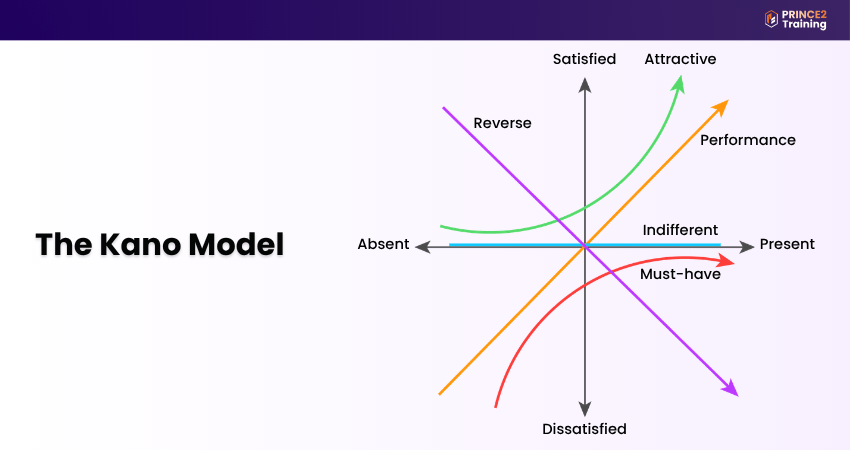
The Kano Model feature categories help teams prioritise features based on their impact on customer satisfaction. These three primary categories drive customer value and guide product decisions. The key categories are explained below:
1) Must-have Features
Must-have features are the must-haves that customers expect as a minimum in any product or service. If these features are missing or fail to perform, customers become dissatisfied. However, when they are present, they do not increase satisfaction because they are simply expected as standard.
2) Performance Features
Performance features are the satisfiers that directly influence customer satisfaction. The better these features perform, the more satisfied customers become. There is a clear, linear relationship between improvement and satisfaction, making these features important for competitive advantage.
3) Attractive Features
Attractive features are the delights that create a strong positive response and memorable user experience. Customers do not expect these features, so their absence does not cause dissatisfaction. However, when included, they surprise users and significantly enhance the overall experience.
4) Indifferent Features
These features do not significantly affect customer satisfaction. Customers neither value nor care about them, so investing in them may not provide meaningful benefits or noticeable improvements. As a result, organisations should avoid spending too much time or resources on these features.
5) Reverse Features
Reverse features create mixed reactions among customers. While some users may like them, others may find them unnecessary or frustrating, potentially leading to dissatisfaction or confusion. This makes it important to carefully evaluate their impact before including them in a product.
Apply PRINCE2 Agile skills to manage projects in dynamic environments. Join for the best
PRINCE2 Agile® Practitioner Training
now!
How to Use the Kano Model?
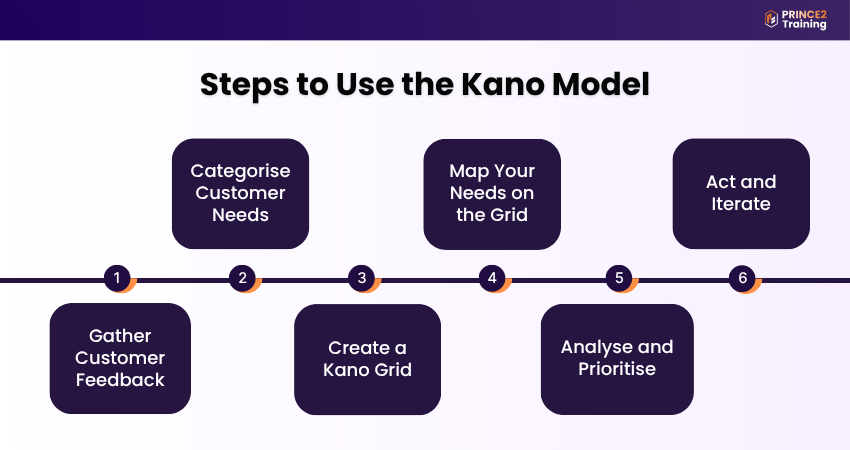
Applying the Kano Model involves a structured process that helps organisations understand customer needs and prioritise features effectively. It enables teams to focus on what customers truly value, reduce guesswork, and make better product decisions. The key steps are outlined below:
1) Gather Customer Feedback
Begin by gathering customer feedback to understand their needs, expectations, and preferences. This can be achieved using surveys, interviews, focus groups, user reviews, or analytics data. Gathering accurate insights at this stage ensures that decisions are based on real customer input rather than assumptions.
2) Categorise Customer Needs
Once feedback is collected, group customer needs into Kano categories such as basic, performance, and excitement features. You may also identify indifferent and reverse features that add little value or cause dissatisfaction. This step helps clarify which features matter most to users.
3) Create a Kano Grid
Create a Kano grid to visually organise features based on their impact on customer satisfaction and functionality for better strategic decision-making and prioritisation. This grid provides a clear overview of how different features contribute to the user experience and supports better planning.
4) Map Your Needs on the Grid
Place each feature on the Kano grid according to its category and overall impact on customer satisfaction levels. For example, basic features sit near low satisfaction but high necessity, while excitement features can drive high satisfaction when implemented well. This mapping helps teams easily identify priorities.
5) Analyse and Prioritise
Use the insights from the grid to prioritise development efforts. Focus first on basic features to avoid dissatisfaction, then improve performance features to increase satisfaction, and finally introduce excitement features to delight customers. Avoid investing heavily in features that do not add value.
6) Act and Iterate
Apply changes based on your analysis and continuously improve your approach. Gather ongoing feedback, monitor customer satisfaction, and adapt to evolving needs. Regular iteration ensures that your product remains relevant, competitive, and aligned with customer expectations.
Build strong Project Management skills from basics to advanced with the
PRINCE2® Foundation & Practitioner Training
– Join now!
Benefits of the Kano Model Analysis
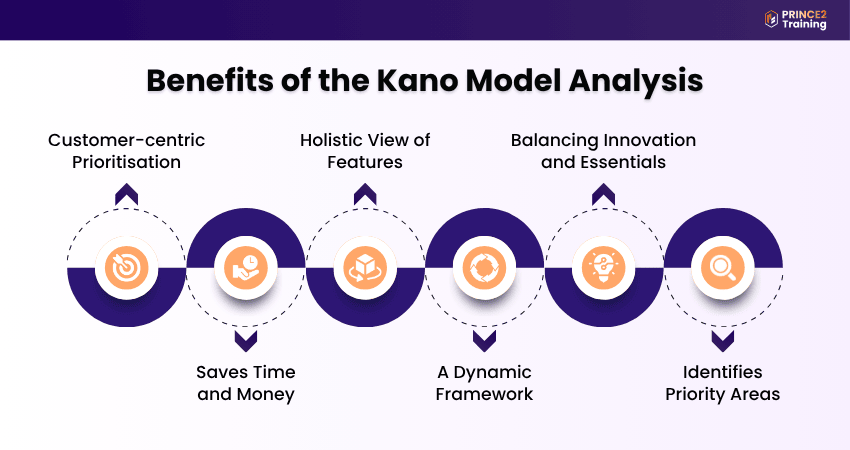
The Kano Model Analysis helps organisations focus on what matters most by linking features to customer satisfaction. It provides a structured, customer-focused approach to decision-making. The key benefits are outlined below:
1) Customer-centric Prioritisation
The Kano Model ensures product decisions are driven by real customer needs and expectations. By analysing how users perceive features in different usage scenarios, teams can prioritise what truly improves satisfaction and loyalty, leading to more relevant products and stronger customer relationships over time.
2) Saves Time and Money
By focusing only on features that add real value, the Kano Model helps reduce unnecessary development efforts. This prevents wasted resources, improves efficiency, and ensures time and budget are invested in features that directly impact customer satisfaction and business outcomes.
3) Holistic View of Features
The Kano Model provides a complete understanding of features by considering both their presence and absence. This broader perspective helps teams evaluate customer reactions more accurately and make better decisions when planning, improving, or removing product features.
4) A Dynamic Framework
Customer expectations evolve over time, and the Kano Model adapts to these ongoing and dynamic changes. It allows teams to continuously reassess feature priorities, ensuring products stay aligned with shifting user needs and stay competitive in an ever-evolving market environment.
5) Balancing Innovation and Essentials
The Kano Model helps organisations balance essential features with innovative ones. While basic features ensure functionality and reliability, excitement features create differentiation and delight, enabling businesses to stand out while still meeting core customer expectations effectively.
6) Identifies Priority Areas
By clearly categorising features based on their overall impact on customer satisfaction levels, the Kano Model helps teams identify high-priority areas. This enables better focus on features that deliver the most value, improve satisfaction, and support strategic product development decisions.
Understand Agile methods and integrate them with PRINCE2 for better outcomes. Join for the best
PRINCE2 Agile® Foundation Training
now!
Challenges of the Kano Model Analysis
The Kano Model is a useful tool, but it also has challenges that can affect its effectiveness. Applying it requires time, effort, and careful interpretation of customer feedback. The key challenges are outlined below:
1) Difficult to Prioritise Within Categories
The Kano Model groups features into categories but does not provide a clear method for ranking features within the same category. For example, many features may fall under performance needs, making it difficult for teams to decide which ones to prioritise without using additional frameworks.
2) Categorisation can be Challenging
Classifying features into the correct categories can be subjective because it relies on diverse and varied customer opinions and perspectives. Different users may have different expectations, making it difficult to achieve consistent results and align teams on feature priorities.
3) Time-consuming Data Collection
Applying the Kano Model requires collecting detailed customer feedback through surveys, interviews, or research across multiple channels and user segments effectively. This process can be time-intensive and resource-heavy, especially for smaller teams or organisations working with limited time and budget.
Conclusion
The Kano Model helps organisations prioritise features based on customer satisfaction, ensuring better product decisions and improved user experience. By understanding what customers expect, value, and enjoy, teams can create meaningful products. When applied effectively, it supports innovation, efficient resource use, and long-term customer loyalty.
Learn PRINCE2 principles to improve project success and team performance through the PRINCE2® Certification – Join now!
Frequently Asked Questions?
The three levels of quality in the Kano Model are basic features, performance features and excitement features. Each level represents a different way in which product attributes influence customer satisfaction
The five commonly recognised Kano categories are basic needs, excitement needs, performance needs, indifferent needs and reverse needs. These categories provide a broader understanding of how features impact customer perception.
The Kano Model is primarily qualitative because it focuses on customer perceptions and feelings. However, it can also incorporate quantitative data through structured surveys and statistical analysis for more accurate results.