

 Back
Back


 Back to
topics
Back to
topics




Table of Contents
 17-Jan-2026
Author-James Smith
Delivering work successfully is no longer just about meeting deadlines. Organisations today need the right leadership to balance speed, quality, and value. That is where the conversation around Delivery Manager vs Project Manager begins. Although both roles contribute to successful outcomes, they focus on different priorities and influence work in distinct ways.
Understanding this difference matters. It helps organisations choose the right role for their goals and gives professionals clearer direction when shaping their careers. In this blog, you will explore the key differences and similarities between Delivery Manager vs Project Manager, so you can confidently understand where each role fits.
What is a Project Manager?
A Project Manager is a professional responsible for planning, organising, and delivering a project. This includes defining objectives, managing scope, allocating resources, setting timelines, and ensuring the project stays on track. Throughout the project lifecycle, they oversee tasks, people, and processes to ensure the work aligns with stakeholder expectations.
Project Managers require strong leadership, strategic thinking, problem-solving abilities, and confidence to thrive in their roles. They are accountable for the overall success of the project, often reviewing performance, implementing improvements, and motivating the team.
What Does a Project Manager Do?
A Project Manager’s responsibilities are mentioned below:
1) Defines Project Scope:
Outlines project goals, deliverables, and success criteria. They work with stakeholders to set requirements, avoid misunderstandings, and reduce delays.
2) Plans and Schedules Tasks:
Breaks the project into manageable tasks, sets deadlines, allocates resources, and tracks milestones using suitable approaches.
3) Manages Budgets and Resources:
Oversees the project finances to make sure work is within the budget by tracking costs, using resources, and adjusting plans when required.
4) Identifies and Mitigates Risks:
Anticipates potential risks, such as changes in scope or resource shortages, and applies risk management strategies to reduce disruption of work.
5) Leads and Coordinates Teams:
Guides, motivates, and supports team members. Also, encourages collaboration, resolves conflicts, and sets clear roles and responsibilities.
6) Manages Stakeholder Communication:
Acts as the main point of contact for stakeholders and customers by addressing concerns, giving updates, and managing expectations.
7) Ensures Quality Control:
Monitors project outputs, applies quality assurance practices, reviews deliverables, and ensures the project results meet agreed standards.

What is a Delivery Manager?
A Delivery Manager is a professional responsible who ensures products and services are delivered to clients smoothly and consistently. They mainly concentrate on execution and outcomes, leading delivery teams, managing budgets, tracking performance, and working closely with clients.
Delivery Managers are accountable for team performance and the delivery of high-value business outcomes, while also building strong client relationships. In this role, the focus is primarily on monitoring progress, analysing data, managing risks, and supporting teams through challenges.
What Does a Delivery Manager Do?
A Delivery Manager’s responsibilities are mentioned below:
1) Removes Obstacles:
Clears blockers, such as approval delays or organisational challenges, by working with stakeholders and ensuring teams work without disruption.
2) Optimises the Workflow:
Refines the processes and systems to boost efficiency, reduce delays, and remove complexity to help teams meet delivery goals.
Facilitates Communication:
Acts as the bridge between technical teams and stakeholders by setting clear expectations, preventing misunderstanding, and supporting collaboration.
Focuses on Agile Principles:
Builds a supportive Agile environment by clearing impediments, adapting workflows, and helping teams to deliver value.
Take your PRINCE2® knowledge to the next level with the
PRINCE2® Practitioner Training
– Join now!
Key Difference Between Delivery Manager and Project Manager
For an effective understanding between Delivery Manager vs Project Manager, it is essential to look at their key differences. This will help professionals to identify which career path suits their goals and organisations to choose the right role for their specific needs. Let’s look at them below.
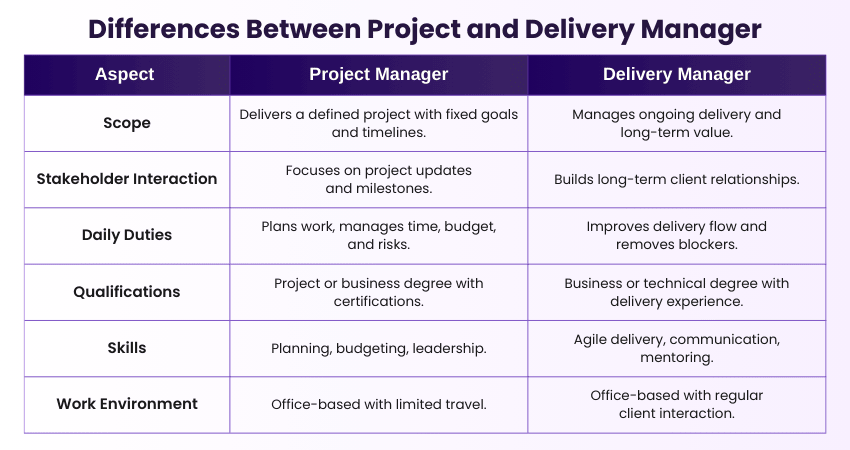
1) Scope
A Project Manager is responsible for delivering a project with defined objectives, timelines, and deliverables. Their scope is usually fixed at the beginning, and success is measured by whether the project is completed on time, within budget, and within scope.
A Delivery Manager oversees ongoing delivery across multiple teams or services. They focus not only on deadlines but are centred on continuous improvement, long-term value, and consistent client satisfaction.
2) Customer & Stakeholder Interaction
Project Managers communicate with stakeholders during the project lifecycle. Their interaction clears the updates and approvals and ensures specific milestones are being met. The interactions are tied mostly to project success.
Delivery Managers act as the main long-term contact for clients. They build strong relationships, manage expectations, and make sure services continue to meet client needs. The interactions are more strategic, and relationship driven.
3) Daily Duties
Project Manager’s daily responsibilities include planning tasks, managing schedules, allocating resources, and tracking progress. They assess risk, implement changes, motivate team members, and ensure work meets quality standards.
Delivery Managers focus on helping teams perform at their best. Their daily work revolves around monitoring delivery performance, analysing data, and Key Performance Indicators (KPIs), improving workflows, removing blockers, and mentoring teams.
4) Qualifications
Usually, Project Managers hold a business or Project Management degree and often gain certifications in recognised methodologies, such as Agile or Scrum. While further studies are optional, the important factor is gaining as much experience as possible.
Delivery Managers generally have a business-related or technical degree, especially in a technology-focused role. Many gain years of Project Management experience before stepping into delivery management as full-time careers.
5) Skills
A Project Manager requires various skills, including project planning, time management, budgeting, risk control, and leadership. They excel at managing project scope and maintaining structured execution within set constraints.
A Delivery Manager requires strong Agile knowledge, stakeholder management, communication, mentoring, and problem-solving skills. Their strengths lie in improving delivery processes and managing risks across services.
6) Work Environments
Project Managers are mostly office-based but may travel depending on the nature of the project. They work across a wide range of industries, including construction, IT, engineering, finance, healthcare, energy, and advertising.
Delivery Managers primarily work in offices but regularly visit clients, suppliers, and delivery teams. They are commonly found in certain industries, such as technology, software development, financial services, healthcare, logistics, and transport.
Combine Agile flexibility with PRINCE2 control and deliver projects confidently with the
PRINCE2 Agile® Practitioner Training
today!
Similarities Between Delivery Manager and Project Manager
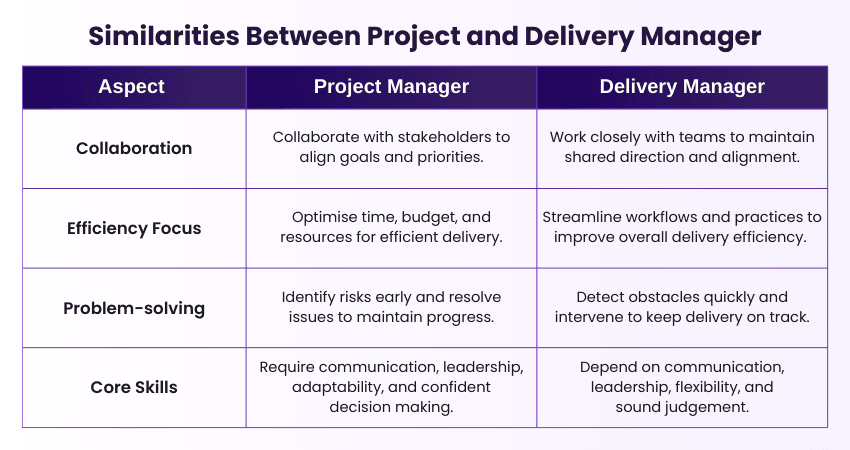
Let’s look at some of the key similarities between Delivery Manager vs Project Manager in the table below:
Conclusion
Success in the modern business world depends on placing the right leadership in the right role. Understanding Delivery Manager vs Project Manager allows organisations to make smarter decisions, improve team performance, and deliver business outcomes. For professionals, it brings clarity on which role matches their skills and career ambitions. This makes it easier to grow, lead, and succeed in today’s delivery focused world.
Build confident projects and strengthen your project skills with PRINCE2® Certification now!
Frequently Asked Questions?
A Delivery Manager is not always higher than a Project Manager. However, the role has a broader focus, overseeing long-term delivery and multiple projects. A Project Manager manages a single project’s scope, time, and budget. They work at the same level with different responsibilities.
No, a Scrum Master is not the same as a Delivery Manager. A Scrum Master focuses on facilitation of Scrum, improving team performance, and removing blockers. A Delivery Manager oversees wider delivery, manages timelines, dependencies, stakeholders, and, at times, budget.
The five levels of Project Management include:
1) Initiation
2) Planning
3) Execution
4) Monitoring and Controlling
5) Closure