

 Back
Back


 Back to
topics
Back to
topics




Table of Contents

 28-Jan-2026
Author-David Walter
Every successful project has two powerful forces behind it: one shaping the direction and the other driving delivery. That is where the Business Analyst vs Project Manager comes in. Although they work closely together, their responsibilities are very different, and confusing the two can lead to misaligned expectations and weaker outcomes.
This blog breaks down the differences between Business Analyst vs Project Manager. You will see how each role contributes to success, how they complement one another, and how understanding this distinction can help teams work smarter and deliver stronger results.
What is a Business Analyst?
A Business Analyst (BA) is a professional who examines business processes, systems, and stakeholder needs to understand how an organisation operates and where improvements can be made. They assess current performance against business goals and objectives, then use their analysis to identify opportunities for improvement, growth, and change.
They often act as a link between Project Managers, senior leaders, and key stakeholders, working together to assess whether proposed projects are feasible and valuable. They also help ensure that business priorities are clearly understood before work begins.
What Does a Business Analyst Do?
A Business Analyst helps organisations understand their needs and solve business problems. Their key responsibilities include:
1) Identifying business needs and challenges.
2) Gathering and documenting stakeholder requirements.
3) Recommending process improvements and effective solutions.
4) Analysing data to support informed decision-making.
5) Facilitating communication between business and IT teams.

What is a Project Manager?
A Project Manager (PM) is a professional responsible for planning, leading, and delivering projects to meet organisational objectives and stakeholder expectations. They oversee key aspects of delivery, including timelines, resources, budgets, and team coordination. When challenges arise, they communicate clearly with stakeholders, manage risks, and justify the need for additional time, resources, or investment to ensure successful outcomes.
What Does a Project Manager Do?
A Project Manager leads the project from start to finish, ensuring it runs efficiently and achieves its objectives. Their key responsibilities include:

1) Defining project goals, scope and success criteria
2) Planning schedules and project activities
3) Managing budgets, costs and resource allocation
4) Leading and motivating the project team
5) Identifying and managing risks and issues
6) Monitoring progress and ensuring the quality standards are met
7) Communicating updates to stakeholders and senior management
8) Making sure that the project is delivered on time and within budget
Difference Between a Business Analyst and a Project Manager
Here are the key differences between Business Analyst vs Project Manager:
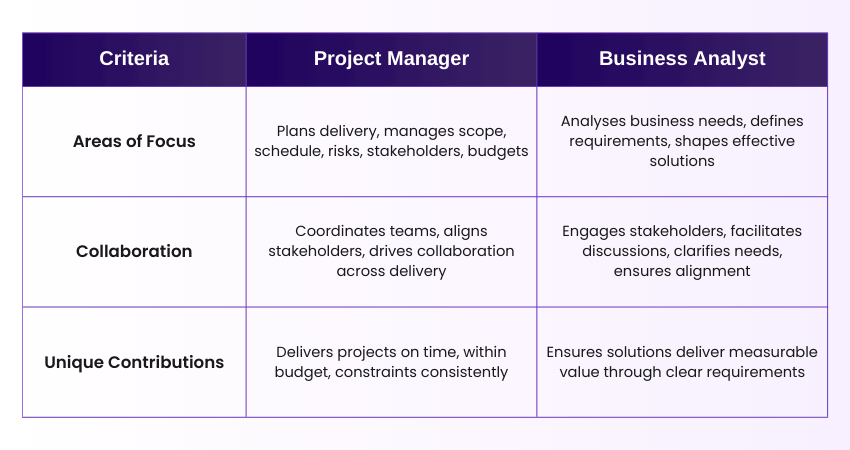
1) Areas of Focus
Project Managers concentrate on managing the entire project. They ensure goals are achieved, tasks are completed on time, risks are controlled, and stakeholders are kept informed. Their role centres on planning, coordination, and delivery.
On the other hand, Business Analysts focus on understanding the business. They gather and document requirements, analyse processes, identify improvement opportunities and use data to support informed decision-making.
2) Collaboration
Business Analysts collaborate closely with stakeholders to gather requirements, clarify expectations, and validate solutions. Project Managers, on the other hand, collaborate with delivery teams and leadership to coordinate tasks, manage dependencies, and keep execution on track.
3) Unique Contributions
Project Managers focus on successful delivery by managing resources, timelines, risks, and constraints. Business Analysts, in contrast, focus on ensuring the project delivers real business value by translating business needs into clear, actionable requirements that support organisational objectives.
Looking to advance your Project Management journey? Our
PRINCE2® Practitioner Training
will lead the way – Register now and elevate your real‑world project mastery!
Business Analyst and Project Manager Skills
Both Business Analysts and Project Managers need strong analytical thinking, clear communication, strategic planning, and attention to detail to perform effectively.
Business Analyst Skills
Here are the key Business Analyst skills:
1) Analytical Thinking:
They assess data and business performance to identify needs and opportunities. This requires critical thinking, accurate analysis, and the ability to communicate findings clearly.
2) Commercial Awareness:
Business improvement often links to sales and market performance. Business Analysts understand sales and marketing concepts, allowing them to interpret trends, forecast outcomes, and build effective business models.
3) Data Analysis:
Business Analysts use data presented in various formats, such as reports and charts, to generate insights that support better decision-making and improved organisational performance.
Project Manager Skills
Here are the core skills required by a Project Manager:
1) Organisation:
Project Managers plan, structure, and track projects from start to finish. Strong organisational skills help them manage resources, timelines, and deliverables efficiently.
2) Leadership:
They guide and motivate project teams, working closely with them to ensure successful delivery. Key leadership traits include communication, empathy, motivation, mentoring, and teamwork.
3) Negotiation:
Acting as a link between teams and senior management, Project Managers use negotiation skills to balance expectations, secure resources, and address challenges that may impact delivery.
Embrace the project approach built for modern agility. Sign up for our
PRINCE2 Agile® Foundation Training
now!
Business Analyst vs Project Manager: Which One is Better?
Neither role is superior to the other. The right choice depends on your interests, strengths, and career goals. Consider the following points.
1) If you enjoy working with data and analysing problems, the Business Analyst role could be a great fit. Business Analysts focus on understanding challenges and shaping solutions, often influencing decisions without being at the centre of delivery.
2) If you prefer leadership, accountability, and team management, the Project Manager role may suit you better. If you enjoy ownership, problem-solving under pressure and driving results, Project Management can be a rewarding career path.
Conclusion
Business Analysts and Project Managers may work side by side, but their impact comes from different strengths. One shapes the 'why' and 'what', the other drives the 'how' and 'when' of the project. Understanding the key Business Analyst vs Project Manager difference can help organisations deliver better results and help professionals choose careers that match their skills, mindset and ambitions.
Build projects that start strong and finish stronger. Register for our
PRINCE2® Certification
now!
Frequently Asked Questions?
No FAQs available