

 Back
Back


 Back to
topics
Back to
topics




Table of Contents

 16-Mar-2026
Author-David Walter
In Project Management, clarity can feel like a rare luxury. That's where business analysis techniques step in, acting as the compass that points Project Managers (PMs) toward sharper insights and smarter decisions. Whether you're navigating shifting requirements or aligning teams around a shared vision, the right tools can calm the chaos.
In this blog, we explore 15 essential Business Analysis Techniques every Project Manager should know to improve project outcomes, align with business goals and lead initiatives with greater confidence. So read on and make your projects exceptional!
What are Business Analysis Techniques?
Business Analysis Techniques refer to some structured methods that help identify an organisation's needs and deliver effective outcomes. This approach involves analysing data, identifying key performance indicators and using various tools to ensure business analysis is aligned with organisational goals. They help uncover opportunities for improvement and recommend innovative solutions. These techniques typically involve:
1) Conducting Market Research: This helps organisations understand industry trends, customer behaviour, and competitor strategies. Business analysts gather information from surveys and market studies to identify opportunities. It helps refine their strategies.
2) Collecting and Analysing Data: This play a vital role in business analysis. Analysts gather relevant data from multiple sources such as internal systems, financial records and customer feedback.
3) Reviewing Existing Processes: Business analysts evaluate current organisational processes to identify bottlenecks or areas that require improvement. By studying workflows and operational procedures, they can determine whether existing systems are meeting business objectives.
4) Identifying Solutions to Complex Challenges: Once challenges and gaps are identified, business analysts develop practical solutions to address them. These solutions may involve process improvements, technology upgrades, or strategic changes.

Why is Business Analysis Important?
Business Analysis helps you understand what needs to change by identifying operational gaps and areas for improvement in your organisation. It helps develop valuable insights to make well-informed choices. Key reasons for using Agile Business Analysis techniques include:
1) Gaining a clear understanding of organisational structure and operations.
2) Identifying current challenges that affect business performance.
3) Highlighting improvement opportunities and practical solutions.
4) Recognising and clearly communicating the need for change.
5) Increasing the overall value delivered to stakeholders.
6) Supporting better planning, risk reduction, and more effective project outcomes.
Top 15 Business Analysis Techniques
Business Analysts use a range of techniques to analyse data, forecast trends, and generate insights that help organisations remain competitive in a dynamic business environment. The following are some of the top Business Analysis Techniques that have become essential tools for professionals in this field:
1) SWOT Analysis
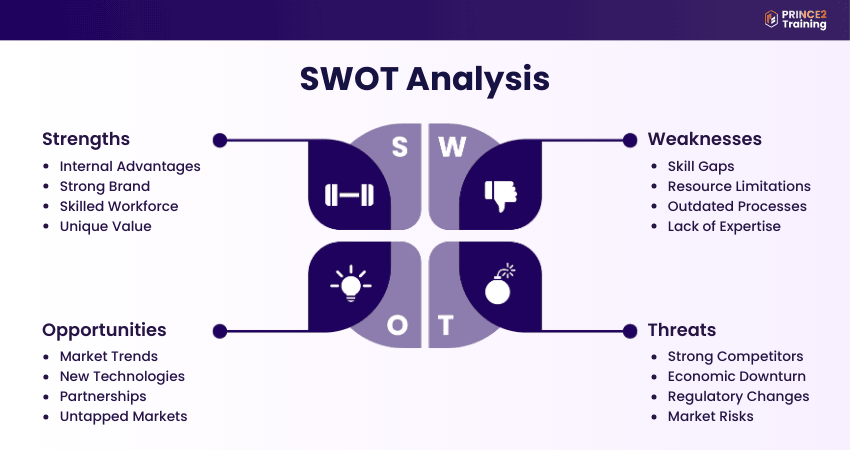
SWOT (Strengths, Weaknesses, Opportunities, Threats) Analysis is a simple tool used to identify the internal and external factors that can influence an organisation. By assessing the strengths and weaknesses as internal factors, and opportunities and threats as external factors, Business Analysts can build strategies that maximise advantages and minimise risks. It upholds strategic planning by helping teams understand their capabilities and address challenges through well-informed decisions.
2) VMOST Analysis
VMOST Analysis is a framework for aligning business activities with an organisation's overall goals and direction. It starts with defining the vision and mission, followed by setting clear objectives, developing strategies to achieve them and finally establishing practical tactics. This approach makes sure that the daily operations consistently support the organisation's broader mission and long-term success.
By applying VMOST Analysis, organisations can clearly understand how different business activities contribute to their strategic goals. It helps leaders prioritise initiatives, maintain consistency across departments and ensure that every action taken within the organisation supports its overall direction.
3) Brainstorming and Mind Mapping
Brainstorming and mind mapping are collaborative techniques for generating a wide range of ideas and solutions for a specific problem. These methods help you organise your thoughts, explore different perspectives and build innovative approaches. They are particularly handy for project planning and encouraging creative contributions from all team members.
Mind mapping visually connects ideas, making it easier to identify relationships between concepts and organise complex information. When combined with brainstorming sessions, these techniques help teams capture ideas quickly, structure them, and transform creative suggestions into practical solutions.
Ensure project structure, strategy and success, the PRINCE2® way in our PRINCE2® Certification - Register now!
4) Gap Analysis
Gap Analysis is used to identify the difference between an organisation's current performance and its desired goals. By evaluating this gap, businesses can uncover shortcomings in processes, resources, or capabilities and determine where improvements are needed to achieve better results. It also helps organisations prioritise actions and develop strategies to effectively close these gaps.
This technique helps decision-makers understand the changes required to move from the current state to the desired future state. By analysing performance gaps, organisations can implement targeted improvements and create action plans that support long-term growth and operational efficiency.
5) Business Process Modelling (BPM)
Business Process Modelling is used to visually represent an organisation's processes through diagrams and flowcharts. It helps businesses identify inefficiencies, improve workflows and make sure that each step aligns with organisational objectives. BPM also supports smoother operations and amplifies overall productivity by creating clearer and more efficient processes.
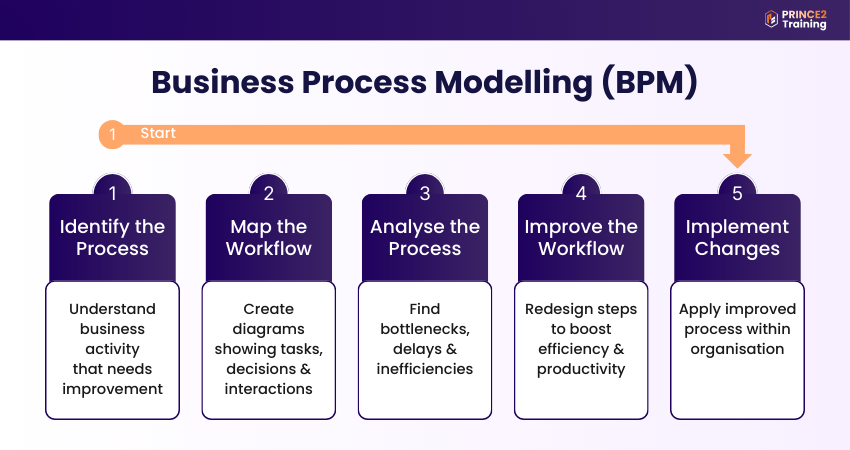
How Business Process Modelling Work?
Through visual representation, teams can better understand how tasks and activities are connected within a workflow. This clarity helps organisations identify unnecessary steps and design processes that are more streamlined, consistent and effective in achieving business goals.
6) Cost-benefit Analysis (CBA)
This is a method for estimating and comparing the expected costs and potential benefits of a project in monetary terms. It helps you assess the feasibility and profitability of a project by evaluating total projected costs (such as investments and operational expenses) against anticipated gains such as revenue or savings.
A key element of CBA is the Net Benefit calculation, which measures the difference between the present value of benefits and costs. If the Net Present Value (NPV) is positive, the project is generally considered financially worthwhile.
7) Data Flow Diagrams
A Data Flow Diagram (DFD) provides a visual glimpse into how information moves within a system. It displays external entities that send or receive data, the processes that transform the data, data storage points and the flow of information between these elements. DFDs are commonly used in the early stages of analysis to support discovery and understanding.
They give organisations a clear view of key data movements in a user-friendly format. Business Analysts collaborate with both business and technical stakeholders to create these diagrams. This helps define project scope and supports more detailed analysis and system design.
8) Wireframing
Wireframing is about creating simple diagrams that outline the basic structure of a web page or user interface, thus showing how the system is expected to function. It acts as a visual blueprint that spotlights key features, layout and user interactions.
Wireframes represent user requirements clearly and can later be enhanced with design elements to create a prototype. Business Analysts use wireframes to gather early feedback and support collaborative software development, especially in Agile environments.
9) Functional Decomposition
Functional Decomposition is the process of breaking down a system, process, functional area or deliverable into smaller components. This approach helps simplify complex activities and makes them easier to understand and manage. The goal of this technique is to create a hierarchical structure that provides a conceptual view of the overall process.
Business Analysts apply Functional Decomposition at different stages of a project, often using diagrams developed during workshops to ensure a shared understanding across the project team.
Great projects happen when strategy meets agility. Our PRINCE2 Agile® Foundation and Practitioner Training will help yopu ensure that - Sign up now!
10) Use Case Modelling
Use Case Modelling is a technique for gathering functional requirements by focusing on the system from the end user's perspective. It outlines specific scenarios, known as "use cases," that describe how users interact with a system to achieve particular goals. This approach helps developers and stakeholders better understand user needs. It ensures that the system is designed to meet expectations and deliver practical functionality.
11) PESTLE Analysis
PESTLE Analysis is a Business Analysis framework used to identify and evaluate external factors that may influence an organisation. The acronym stands for Political, Economic, Sociological, Technological, Legal, and Environmental factors, all of which can affect business operations and strategy. It includes:
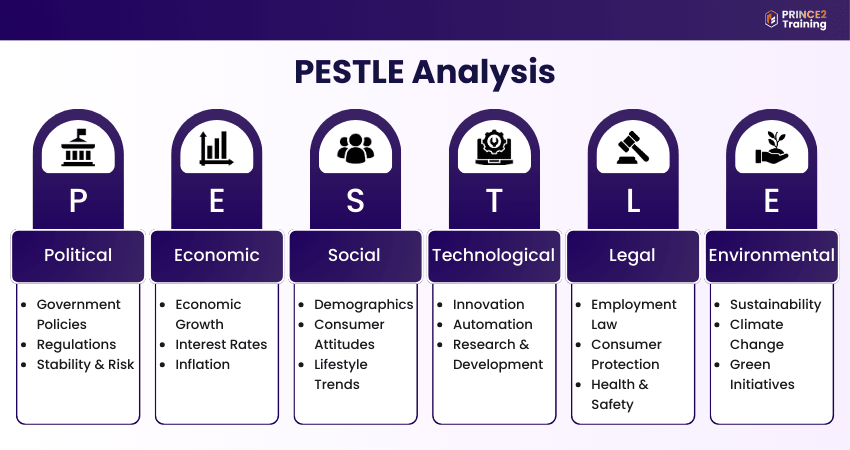
a) Political Factors: This involves government policies, regulations, and political stability that may influence business activities.
b) Economic Factors: This involves aspects such as inflation, interest rates, energy prices, and labour costs that can impact financial performance.
c) Sociological Factors: This focuses on cultural trends, demographics, and social behaviours that may affect consumer demand and business practices.
d) Technological Factors: This refers to technological developments, innovation, IT infrastructure, and communication systems that can shape business growth.
e) Legal Factors: This include laws, compliance requirements and regulations that organisations must follow.
f) Environmental Factors: These consider the impact of environmental issues, sustainability and ecological conditions on business operations.
12) The 5 Whys
The 5 Whys is a Root Cause Analysis (RCA) technique used in Business Analysis to identify the underlying reason behind a problem. It involves repeatedly asking "why," typically five times, to move beyond surface issues and uncover the true cause of a situation. This method helps organisations understand why a process is underperforming or why a project may be delayed.
By identifying the root cause, you can implement effective solutions that address the real issue and reduce the chances of it happening again. The 5 Whys technique is simple yet highly effective because it encourages deeper investigation rather than quick assumptions. It also promotes critical thinking and collaborative problem-solving within teams.
Move from knowledge to practical project leadership with our PRINCE2® Practitioner Training - Register now!
13) MoSCoW
The MoSCoW Method is used to prioritise requirements based on their importance to business objectives. It helps Business Analysts decide which elements are essential for a project and which can be deferred. MoSCoW stands for Must have, Should have, Could have, and Won't have:
a) Must-have Requirements: These are critical for the project's success and must be delivered to meet business objectives.
b) Should-have Requirements: These are important but not essential. They can be implemented if time and resources allow.
c) Could-have Requirements: These are desirable features that add value but are not necessary for the project to succeed.
d) Won't-have Requirements: These refer to requirements that are considered out of scope or not required for the current project phase.
14) Requirements/Design Workshops
Requirements or Design Workshops are commonly used during the analysis and design stages of a project. Their size, frequency, focus and format may vary depending on the project's scope and complexity. Unlike one-to-one interviews, workshops bring together multiple stakeholders to discuss specific process or design topics in a structured way.
In these sessions, the Business Analyst typically acts as the organiser and facilitator. This ensures that workshop objectives are clear, discussions remain productive, and key outcomes, such as decisions and requirements, are properly documented.
15) CATWOE
CATWOE is a problem-solving and decision-making technique for analysing complex situations from multiple perspectives. The acronym stands for Customers, Actors, Transformation process, Worldview, Owners, and Environmental constraints. This framework helps organisations clearly understand problems and develop well-structured solutions:
1) Customers are the people or groups affected by the problem or decision.
2) Actors are the individuals responsible for carrying out the activities involved in the process.
3)Transformation process refers to the actions that convert inputs into meaningful outputs.
4) Worldview represents the perspectives of stakeholders, explaining why the organisation exists and what it aims to achieve.
5) Owners are the individuals or groups who have the authority to make decisions or approve changes.
6) Environmental constraints include external limitations or factors that may influence the problem or decision.
Conclusion
Mastering the Business Analysis Techniques outlined in this blog will empower you to turn ideas into actionable strategies with greater confidence. By understanding problems, analysing data and prioritising properly, Project Managers can drive projects with clarity. The right techniques not only improve decision-making but also ensure that projects deliver real business value, no matter how much the environment evolves.
Master the art of justifying better business investments with our Better Business Cases Training - Sign up now and win stakeholder confidence!
Frequently Asked Questions?
The four common types of Business Analysis are:
a) Strategic Analysis
b) Business Process Analysis
c) Requirements Analysis
d) Systems Analysis
Together, they help organisations understand business needs, improve processes, define solutions and ensure systems support overall business goals.
The 5 C’s of Business Analysis typically refer to:
a) Customers
b) Competitors
c) Company
d) Collaborators
e) Context
These elements help the Analysts understand the business environment, evaluate the opportunities and make informed strategic decisions.
The six core concepts defined in the Business Analysis Core Concept Model (BACCM) are Change
a) Need
b) Solution
c) Stakeholders
d) Value
e) Context
These concepts explain how business analysis creates value by addressing organisational needs and enabling effective change.