

 Back
Back


 Back to
topics
Back to
topics




Table of Contents
 07-Mar-2026
Author-Veronica Davis
Projects are becoming smarter, faster and more data-driven, and Artificial Intelligence is at the centre of this transformation. AI has emerged as the ultimate co-pilot for Managers and teams to reach new heights of project success. From redefining team roles to automating repetitive tasks, AI Project Management is reshaping what’s possible.
As organisations harness intelligent insights and predictive power, project success becomes less about guesswork and more about smart, data-driven decisions. This blog explores the power and the future of AI Project Management, its types, benefits, challenges and more. So read on and digitise your Project strategies like never before!
What is AI Project Management?
AI Project Management refers to the use of Artificial Intelligence to support project planning, execution and performance tracking. It allows teams to leverage automation and predictive insights to improve accuracy. Rather than relying only on human judgment, AI systems can analyse large volumes of data quickly to guide decisions and streamline workflows.

Role of AI in Project Management
From initial planning to final evaluation and continuous improvement, Artificial Intelligence plays a significant role throughout the entire project lifecycle. It works as a smart assistant, helping Project Managers make proactive decisions. Here are some of the key ways through which AI contributes to modern Project Management:
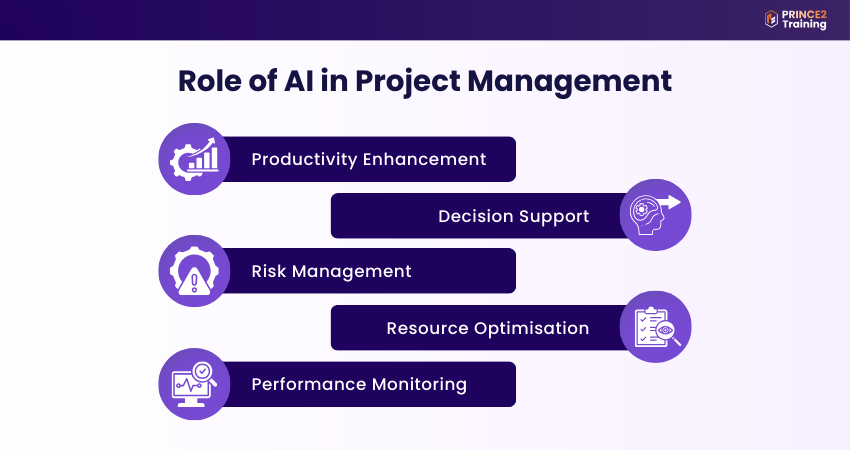
1) Productivity Enhancement:
AI automates repetitive tasks such as scheduling, documentation, and reporting. As a result, project teams can focus more on value-driven activities.
2) Decision Support:
AI-powered analytics help decode raw project data. This enables Project Managers to review performance metrics and make accurate decisions supported by real-time information.
3) Risk Management:
Machine Learning models analyse historical and current project data to detect early risk indicators. This helps teams identify cost overruns or quality challenges before they become major issues.
4) Resource Optimisation:
Advanced forecasting tools assist in allocating resources by identifying the right people and assets for specific tasks.
5) Performance Monitoring:
AI-enabled dashboards provide real-time visibility into project progress and quality metrics. This allows teams to respond quickly and improve processes.
Types of AI Used in Project Management
AI applications in Project Management can be grouped into several key categories. Here we explore each type:
1) Predictive Analytics AI
This type of AI analyses historical project data to forecast possible outcomes such as project delays, budget overruns, resource gaps, and potential risks. These insights help Project Managers make quicker, data-driven decisions and improve their planning accuracy.
2) Automation and Workflow AI
Automation tools reduce repetitive administrative work by handling tasks like reminders, status notifications, report creation and meeting scheduling. This allows teams to focus more on high-value activities.
3) Natural Language Processing (NLP) AI
NLP enables systems to understand and generate human language. In Project Management, it supports tasks like creating summaries, extracting insights from documents, preparing meeting notes and analysing communication such as emails.
4) Risk Management AI
Risk-focused Artificial Intelligence examines patterns within project data to detect dependencies, identify high-risk tasks, uncover financial concerns and highlight operational bottlenecks before they escalate.
5) Resource Optimisation AI
This form of Artificial Intelligence assists in assigning tasks effectively by evaluating team members’ skills, availability, workload and previous performance to ensure the resources are utilised efficiently.
How to Use AI in Project Management?
AI can be applied in Project Management by integrating intelligent tools that analyse data and support decision-making across multiple projects. Here are some practical ways organisations use AI in Project Management:
1) Use Predictive Insights for Planning:
AI analyses previous project data to forecast workloads, timelines, and potential bottlenecks. This enables Managers to plan projects more accurately and prevent resource shortages or delays before they occur.
2) Improve Resource Management:
AI-powered tools match available skills, experience, and capacity with project demands. This ensures the right people are assigned to the right tasks while balancing workloads.
3) Detect Risks Early:
AI can identify patterns in project data and highlight potential risks, dependencies and future bottlenecks. This enables teams to take corrective action early.
4) Automate Routine Tasks:
Many AI Project Management platforms automate repetitive activities such as reporting, scheduling and data processing. This saves time and improves efficiency.
5) Support Data-driven Decision-making:
AI consolidates large volumes of project data and presents actionable insights, helping Managers prioritise tasks, optimise workflows, and improve overall project performance.
Upgrade your project mindset and elevate your career with our range of
PRINCE2® Certifications
- Sign up now!
Top AI Tools for Project Management
Modern organisations increasingly use advanced AI-powered Project Management tools. These platforms combine Machine Learning, Predictive Analytics and automation to simplify complex workflows. Below are some of the most widely used AI tools transforming Project Management today:
1) Wrike AI:
Wrike integrates AI capabilities to analyse project data, predict risks, prioritise tasks, and provide performance insights, enabling Project Managers to make proactive decisions.
2) Asana Intelligence:
Asana Intelligence applies AI to analyse project data, predict potential delays, and automate workflow steps. It helps teams prioritise tasks, track progress effectively, and maintain smooth project execution.
3) ClickUp AI:
ClickUp AI improves productivity by automatically generating summaries, creating reports, and organising project information. It can also transform discussions or notes into structured tasks and updates, saving Project Managers significant time.
4) Notion AI:
Notion AI boosts collaboration and documentation by assisting with report writing, meeting summaries and knowledge organisation. This helps teams maintain clear communication and centralised project information.
5) Trello with Butler Automation:
Trello’s Butler feature automates routine workflows; triggers actions based on rules and streamlines task management. This reduces manual effort and improves team productivity.
6) Monday.com AI:
Monday.com uses AI to automate workflows, analyse workloads and provide smart recommendations that help teams manage projects more efficiently and stay aligned on goals.
7) Motion AI:
Motion leverages AI to automatically plan schedules, prioritise tasks and optimise individual workloads, making project timelines more realistic and manageable.
Benefits of AI in Project Management
AI has the potential to amplify Project Managers' and teams' capabilities at every stage of a project. Here are some of the key benefits AI brings to Project Management:
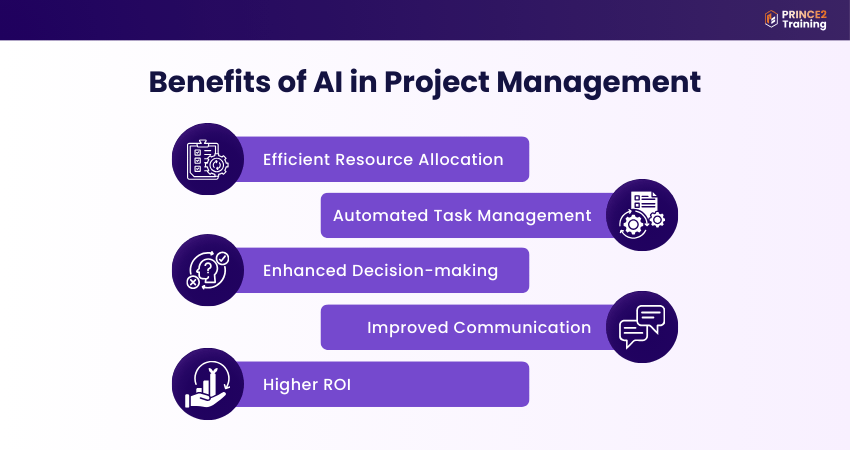
1) Efficient Resource Allocation
Successful project delivery relies on assigning the right resources at the right time. AI analyses aspects such as project requirements, team skills and resource availability to recommend optimal allocation. This helps improve productivity and minimise resource conflicts.
2) Automated Task Management
AI can streamline routine project activities such as scheduling, tracking progress and updating project statuses. Automating these tasks reduces manual workload and maintains smoother project operations.
3) Enhanced Decision-making
AI technologies help organisations make faster and more informed decisions. Machine Learning can analyse large datasets to identify anomalies and trends, while NLP extracts insights from feedback and research reports.
4) Improved Communication
Clear communication is key to collaboration. AI tools can record meetings, transcribe conversations and summarise key discussions to ensure important information is captured and shared easily. AI can also update dashboards, Kanban boards and collaboration platforms in real time.
5) Higher ROI
Organisations that adopt AI-driven tools often experience better financial outcomes from their projects. By using automation and intelligent insights, teams can optimise resources and increase the likelihood of surpassing their expected Return on Investment (ROI).
Embrace the hybrid project power of PRINCE2® and Agile in our
PRINCE2 Agile® Practitioner Training
– Sign up now!
Limitations and Challenges of AI in Project Management
Although AI offers many advantages, integrating it into Project Management also comes with several challenges. Addressing these issues is important to ensure effective, responsible, and sustainable adoption.
1) Data Quality:
AI systems rely heavily on accurate data. If the information used is incomplete or incorrect, it can result in unreliable insights and damaging project decisions.
2) High Implementation Costs:
Adopting AI often requires big investment in technology, infrastructure and employee training, which can be challenging for some organisations.
3) Ethical Concerns:
Maintaining transparency and accountability in AI-supported decisions is a challenge as it’s essential to building trust and ensuring responsible usage.
4) Skills Gap:
Many organisations struggle in finding professionals who possess both AI knowledge and Project Management expertise.
5) System Integration Challenges:
Incorporating AI into existing tools, processes and legacy systems can be technically demanding. This may require additional time and resources.
Best Practices for AI Project Management
Adopting the right strategies can make the implementation of AI-powered Project Management tools smoother. The following practices can help organisations successfully integrate AI into their project workflows:
1) Choose the Right Tools
With a growing number of AI solutions available, it is important to pick tools that align with your organisation’s Project Management requirements. Prioritise platforms that integrate easily with the systems and tools your teams already use.
2) Ensure the Quality and Security of Your Data
AI tools deliver the best results when they rely on complete and secure data. So, establish strong data management policies and technologies to ensure the information used by AI systems remains reliable and protected.
3) Provide Adequate Training
Even the most user-friendly AI tools need adequate training. Offering guidance, learning resources or self-paced training helps teams understand how to use these tools properly and maximise their benefits.
4) Encourage Collaboration
Effective collaboration is necessary for successful Project Management. The AI tools you adopt must support communication, transparency and coordination between project teams and stakeholders.
Build your Project Management backbone and start strong with our
PRINCE2® Foundation Training
- Register now!
The Future of AI in Project Management
Organisations that adopt AI-enabled tools will be better equipped to manage complex projects and achieve stronger results. Rather than replacing Project Managers, AI will act as a powerful assistant. It’s projected that due to the increasing role of AI, 80% of current Project Management tasks will be eliminated by 2030. Here are some ways AI will continue to transform the future of Project Management:
1) Hyper‑automation of Workflows:
AI will handle routine tasks like scheduling, reporting and resource allocation, thus allowing Project Managers to keep their focus on strategy and leadership.
2) Human-AI Hybrid Roles:
Project Managers will evolve into “AI orchestrators,” combining human judgment with machine intelligence for high‑precision management.
3) Predictive Project Intelligence:
Advanced algorithms will forecast risks, delays and budget issues before they happen.
4) AI‑Enhanced Collaboration:
Smart assistants will streamline communication, summarise meetings, and ensure alignment across distributed teams.
5) Data‑driven Decision Ecosystems:
Projects will increasingly rely on real‑time data insights, making decisions more accurate and less dependent on guesswork.
6) Adaptive and Self-optimising Systems:
AI tools will continuously learn from project outcomes, automatically improving processes, estimates, and delivery models.
Conclusion
Artificial Intelligence is reshaping the way modern projects are managed. By supporting smarter decisions and strengthening collaboration, AI Project Management helps project teams achieve better outcomes. As technology continues to evolve, those organisations that embrace AI in their Project Management efforts will be better prepared to lead and innovate.
Turn your grasp on project theory into real-world mastery with our comprehensive
PRINCE2® Practitioner Training
- Sign up today!
Frequently Asked Questions?
Common Project Management challenges include scope creep, poor communication, limited resources, unrealistic deadlines, and unclear accountability. Weak risk planning and resistance to change can also disrupt progress. Clear goals, strong communication, and proactive risk management help keep projects on track.
Project Management methodologies are structured frameworks, such as Agile, Waterfall, Scrum, Kanban, Lean, and Six Sigma, that guide how projects are planned, executed, and controlled. They range from sequential to flexible approaches, helping teams optimise workflow, quality, and speed based on project needs and complexity.
Agile Principles emphasise flexibility, collaboration, and continuous improvement in project delivery. They focus on delivering value through iterative progress, regular feedback, and adapting quickly to change, while prioritising teamwork, customer involvement, and practical working solutions.